
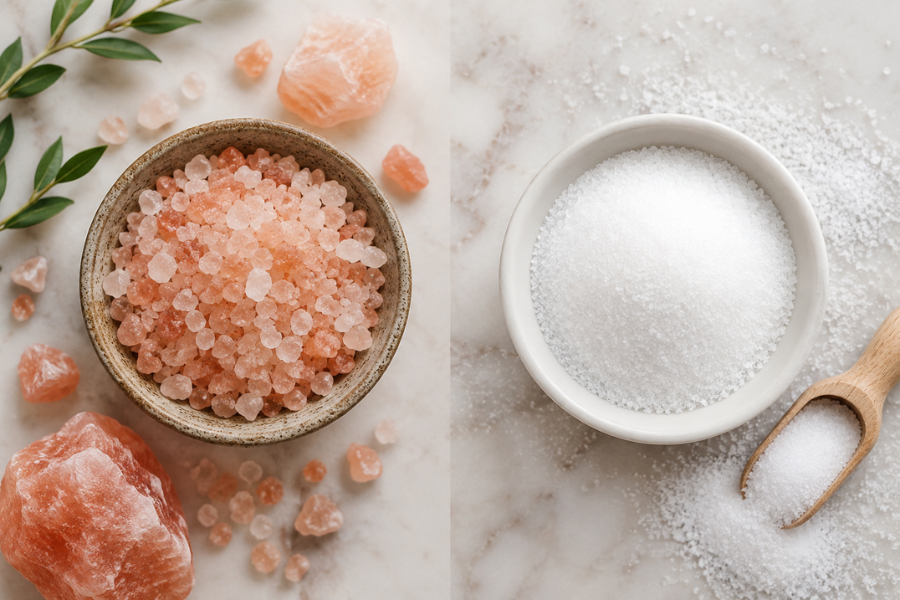
Salt is one of the most essential ingredients in food preparation and food manufacturing, yet it is often misunderstood as a single, uniform product. In reality, different types of salt vary significantly in how they are sourced, processed, and used. Edible Himalayan salt and table salt are two of the most commonly compared options, particularly as consumers and manufacturers become more conscious about ingredient transparency and food quality. Edible Himalayan salt is sourced from ancient mineral deposits in Pakistan and is minimally processed, while table salt is industrially refined and chemically treated for mass consumption. These differences affect not only taste and appearance but also processing behavior, labeling, and market perception. Understanding how edible Himalayan salt compares to table salt helps food manufacturers, buyers, and processors make informed decisions that align with product goals, regulatory requirements, and evolving consumer expectations.
Differences in origin and sourcing
The origin of salt plays a critical role in how it is perceived and utilized within the food industry. Edible Himalayan salt is mined from prehistoric salt deposits located primarily in the Khewra region of Pakistan. These deposits were formed millions of years ago when ancient seas evaporated, leaving behind mineral-rich salt layers that have remained protected underground. Because of this isolation, the salt is often considered naturally pure and free from modern environmental contaminants. Table salt, in contrast, is sourced from a variety of locations around the world, including underground mines, salt flats, and seawater evaporation facilities. Its geographic origin is rarely emphasized, as it is treated as a global commodity. For food brands and manufacturers, Himalayan salt’s clear origin supports traceability and storytelling, while table salt prioritizes scalability and cost efficiency over geographic identity.
Processing methods and refinement levels
Processing is one of the most important distinctions between edible Himalayan salt and table salt. Edible Himalayan salt undergoes minimal processing that typically involves washing to remove surface debris, drying, crushing, and grading into different grain sizes suitable for food use. No chemical bleaching or artificial additives are introduced during this process. Table salt, on the other hand, is heavily refined to strip away natural minerals, resulting in nearly pure sodium chloride. It is often treated with anti-caking agents to improve flow and may be iodized to address dietary iodine deficiencies. These refining steps enhance shelf stability and uniformity but reduce the salt’s natural composition. For food processors, this difference matters because processing methods influence clean-label eligibility, ingredient declarations, and consumer trust.
Mineral content and visual appearance
Edible Himalayan salt contains naturally occurring trace minerals such as calcium, magnesium, potassium, and iron, which are preserved through minimal processing methods. These minerals give the salt its distinctive pink, orange, or light reddish color and contribute to subtle variations in crystal structure and texture. While the mineral content is not nutritionally significant in large-scale diets, it plays an important role in visual appeal, perceived quality, and premium positioning. Regular table salt appears bright white because all trace minerals are removed during industrial refining and chemical treatment. From a food manufacturing and packaging perspective, the natural appearance of Himalayan salt can influence consumer perception, especially in transparent packaging or high-end product lines. Its unique coloration is often associated with authenticity, mineral richness, and minimal processing, reinforcing premium positioning and brand credibility, whereas table salt’s uniform whiteness reflects industrial refinement, standardization, and lower perceived value in specialty or clean-label markets.
Flavor profile and taste differences
Taste is one of the most noticeable differences between edible Himalayan salt and table salt. Edible Himalayan salt offers a smoother, milder salinity that enhances flavors without overwhelming them. Many chefs and food developers describe its taste as more balanced and less sharp. Table salt delivers a stronger, more immediate salty impact due to its highly refined structure and absence of other minerals. In food processing, this difference can affect formulation decisions, particularly for products where flavor nuance is important. Edible Himalayan salt allows for more controlled seasoning, while table salt provides predictable intensity. Both can be used effectively, but the choice depends on the desired flavor profile and product positioning.
Performance in cooking and food preparation
In everyday cooking and commercial kitchens, both edible Himalayan salt and regular table salt perform reliably, but they behave slightly differently depending on the intended culinary application. Edible Himalayan salt crystals can vary in size, density, and texture, which may affect dissolution rates, flavor release, and seasoning control during cooking or food preparation. This makes it especially suitable for finishing dishes, slow cooking, brining, curing, and seasoning throughout preparation processes where texture and visual appeal matter. Table salt dissolves quickly and evenly due to its fine, uniform crystalline structure, making it ideal for baking, processed foods, and precise culinary formulations. Food professionals and manufacturers choose between these salts based on control, consistency, performance, and presentation goals. While table salt is favored for technical precision and standardized processes, edible Himalayan salt is often selected for its natural image, mineral content, premium perception, and versatile culinary applications across home kitchens, restaurants, and industrial food production environments.
Use in food manufacturing and processing
In industrial food manufacturing and large-scale commercial production, salt must perform consistently and reliably across high-volume production lines. Table salt has long been the standard due to its low cost, fine and uniform grain structure, ease of handling, and predictable dissolution properties. Edible Himalayan salt is increasingly adopted in clean-label, organic, natural, and premium product lines where ingredient sourcing, traceability, and minimal processing methods are integral to brand value and consumer perception. When properly graded, tested, and supplied with documentation, it integrates smoothly into modern production systems without compromising efficiency, taste, or shelf stability. The decision between table salt and Himalayan salt often reflects overall brand strategy, market positioning, and target consumers rather than technical limitations. Manufacturers producing mass-market, industrial, or cost-sensitive foods may prefer table salt, while those focusing on natural, specialty, wellness-oriented, or high-end products often choose edible Himalayan salt to support both functional performance and marketing differentiation.
Clean-label implications and consumer perception
Consumer perception increasingly plays a critical role in ingredient selection, brand positioning, and purchasing decisions. Edible Himalayan salt is widely perceived as a more natural and authentic ingredient because it is minimally processed, free from chemical additives, and retains its natural mineral content and pink coloration. This perception strongly supports clean-label claims and aligns with growing consumer demand for simple, recognizable, and transparently sourced ingredients. Table salt, although safe, widely available, and functionally effective, is often viewed as overly processed due to refining, bleaching, and chemical treatments, which can impact brand image in premium or health-focused product categories. For food manufacturers and brands, this difference directly influences marketing strategies, product labeling, consumer trust, and long-term brand loyalty. Clean-label positioning, coupled with traceability and minimal processing, has become a major driver in the adoption of edible Himalayan salt across organic, wellness-oriented, and high-end food markets worldwide, helping companies differentiate their products in increasingly competitive sectors.
Shelf life, storage, and handling considerations
Both edible Himalayan salt and table salt have long shelf lives when stored properly, but they differ slightly in handling, storage, and environmental requirements. Table salt’s anti-caking agents help prevent clumping and ensure free-flowing consistency in humid or variable conditions, making it easier to handle in large-scale industrial operations. Edible Himalayan salt, particularly fine or granular grades, may absorb moisture more readily and therefore often requires controlled storage conditions, protective packaging, and careful handling to maintain product integrity. Proper packaging, moisture-proof containers, and workflow management help minimize these differences and preserve quality. Food processors and manufacturers must consider environmental conditions, storage infrastructure, climate control, and operational efficiency when selecting between the two salts. Attention to these factors ensures consistent product performance, reduces waste, maintains mineral integrity, and supports reliable distribution across domestic and international supply chains.
Cost differences and sourcing economics
Cost is a significant factor in salt selection, particularly for bulk buyers, food manufacturers, and industrial processors. Table salt is generally less expensive due to large-scale production, mechanized processing, and widespread global availability. Edible Himalayan salt carries a higher price point because of limited mining locations, manual extraction, careful grading, and international export logistics. However, many manufacturers consider this additional cost an investment in product differentiation, clean-label positioning, and enhanced brand value. In premium, organic, or specialty food markets, the higher ingredient cost is often offset by stronger consumer appeal, premium retail pricing, and marketing advantages. Sourcing decisions must carefully balance budget constraints, production efficiency, and ingredient availability with marketing, brand positioning, and long-term product strategy objectives. Proper supplier selection, traceability, and bulk purchasing can also optimize cost-effectiveness while ensuring consistent quality and reliability in global supply chains.
Regulatory standards and food safety compliance
Both edible Himalayan salt and table salt must meet strict international food safety standards, regulations, and industry-specific requirements to be used safely in food production. Table salt benefits from standardized regulations, long-standing market acceptance, and widely recognized quality benchmarks. Edible Himalayan salt requires careful verification to ensure food-grade quality, including laboratory testing, microbial analysis, mineral composition verification, and origin documentation. Reputable suppliers provide detailed certificates, traceability records, and third-party certifications to support full regulatory compliance. For food manufacturers and processors, working with trusted, experienced suppliers is essential regardless of salt type to ensure product safety, consistent quality, operational reliability, and adherence to local, national, and international regulatory frameworks. Proper documentation, supplier audits, and ongoing quality monitoring further minimize risk, reinforce consumer trust, and support long-term business success in both domestic and export markets.
Conclusion
Choosing between edible Himalayan salt and table salt depends on more than just functionality, cost, or ease of use in production. Table salt remains a reliable, widely available, and cost-effective option for conventional food manufacturing and large-scale industrial production. Edible Himalayan salt offers a natural, minimally processed, traceable alternative that supports clean-label positioning, premium branding, and consumer-perceived quality. Both salts perform essential roles in food processing, seasoning, and preservation, but their differences in origin, processing methods, crystal structure, and consumer perception shape how they are applied in specific culinary or industrial contexts. By fully understanding these distinctions, food manufacturers, B2B buyers, and product developers can confidently select the salt that best aligns with production efficiency, regulatory compliance, brand strategy, consumer expectations, and long-term business objectives across domestic and international markets.