
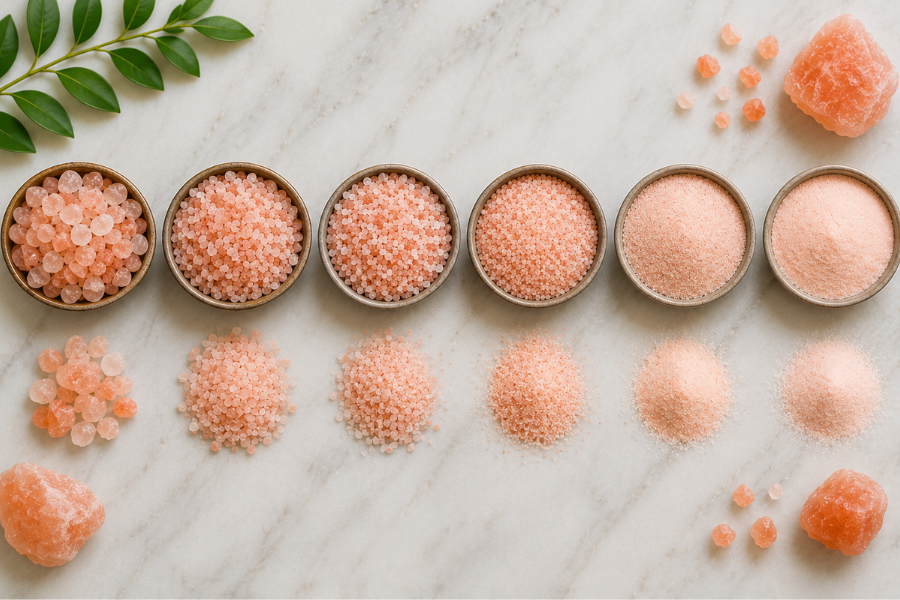
Edible Himalayan salt is not a one-size-fits-all ingredient. Its functionality, flavor delivery, and suitability for food applications depend heavily on grain size. From fine powder used in baking and food manufacturing to coarse crystals preferred for cooking and finishing, each grain size serves a distinct purpose. Food manufacturers, chefs, and bulk buyers must understand these differences to select the right salt for their specific needs. Unlike refined table salt, edible Himalayan salt is minimally processed, which means grain size directly influences dissolution rate, texture, and seasoning control. This guide explains the major grain sizes of edible Himalayan salt, how they are produced, and how they are used across culinary and industrial food processing environments.
Why grain size matters in edible Himalayan salt
Grain size plays a critical role in how edible Himalayan salt performs in food preparation and manufacturing. Larger grains dissolve more slowly, allowing gradual seasoning and textural contrast, while finer grains dissolve quickly and distribute evenly. In food processing, consistency in grain size ensures predictable results across batches, which is essential for quality control. Grain size also affects moisture absorption, flowability, and packaging efficiency. For example, fine salt works best in dry mixes and baking, while coarse salt is better suited for cooking and finishing. Understanding grain size helps food producers maintain flavor balance, reduce waste, and improve operational efficiency. Choosing the correct grain size is not just a culinary decision but a technical one that directly impacts product quality and consumer experience.
Fine grain edible Himalayan salt
Fine grain edible Himalayan salt is the most commonly used format in food manufacturing and home kitchens. It closely resembles refined table salt in texture but differs significantly in processing and composition. This grain size dissolves rapidly, making it ideal for baking, soups, sauces, spice blends, and processed foods where uniform salt distribution is critical. Food manufacturers prefer fine grain salt for its ability to integrate seamlessly into formulations without altering texture or appearance. In clean-label products, fine Himalayan salt replaces refined salt without requiring recipe changes. Its consistent particle size supports automated production systems, ensuring accuracy and repeatability. Despite its small size, fine grain Himalayan salt retains its natural mineral composition, making it a popular choice for premium and natural food products.
Extra fine (powder) Himalayan salt for food processing
Extra fine or powdered Himalayan salt is specifically produced for industrial food applications that require instant solubility. This grain size is commonly used in seasoning mixes, instant foods, snack coatings, and liquid food formulations. Because it dissolves almost immediately, it ensures uniform salinity without visible salt particles. Powdered Himalayan salt is especially useful in dry blends where even dispersion is essential. Food processors rely on this format to maintain product consistency while meeting clean-label requirements. Proper handling and moisture control are important, as finer grains can absorb humidity more easily. When stored correctly, powdered Himalayan salt delivers excellent performance in high-volume food manufacturing environments where precision and speed are critical.
Medium-grain Himalayan salt
Medium-grain edible Himalayan salt strikes a balance between quick dissolution and textural presence. It is commonly used in cooking, seasoning during preparation, and general culinary applications. This grain size dissolves steadily, allowing cooks and processors to control saltiness gradually. In food service and restaurant kitchens, medium-grain salt is favored for versatility, as it works well for both cooking and light finishing. Food manufacturers use it in ready meals and processed foods where controlled flavor release is desirable. Medium-grain salt also performs well in salt grinders designed for consistent output. Its adaptability makes it one of the most widely used grain sizes across both professional and consumer markets.
Coarse grain edible Himalayan salt
Coarse-grained Himalayan salt is characterized by larger crystals that dissolve slowly and provide a noticeable texture. It is commonly used for cooking techniques such as roasting, grilling, and boiling, where gradual salt release enhances flavor penetration. In culinary settings, coarse salt is also used as a finishing ingredient to add crunch and visual appeal. Food processors use coarse salt in applications like curing, brining, and specialty food production where controlled salt absorption is required. Because of its size, coarse salt is less prone to clumping and easier to handle in humid environments. Its natural appearance supports premium branding, making it popular in gourmet and artisanal food products.
Himalayan salt granules for grinders and mills
Granular Himalayan salt is specifically sized for use in salt mills and grinders. These granules are larger than medium grain salt but more uniform than coarse chunks. This consistency ensures smooth grinding and even seasoning at the table or during cooking. Granular salt is popular in retail packaging, food service, and hospitality settings where freshness and customization are valued. Food brands often package this grain size in refillable grinders to emphasize quality and natural sourcing. In processing environments, granules may also be used in controlled applications where slow dissolution is desired. The uniformity of granules ensures predictable performance and enhances user experience.
Himalayan salt chunks and rock salt (edible grade)
Edible Himalayan salt chunks represent the largest grain size and are commonly used in specialty culinary and processing applications. These large crystals dissolve very slowly, which makes them ideal for brining, salt crust cooking, and decorative food presentations. In industrial food processing, chunks may be used to prepare concentrated brine solutions, adding salinity gradually over time while maintaining consistent flavor. Chunk salt is visually appealing and reinforces the perception of natural, artisanal ingredients, particularly in gourmet or premium food products. Its slow solubility allows precise control of salt penetration in slow-cooked dishes, curing processes, or fermented foods. Chefs and processors value chunk salt not only for functionality but also for storytelling and visual differentiation. Proper handling and grading are essential to ensure food safety and consistent results. Chunk salt complements fine, medium, and coarse grain options, completing the spectrum of edible Himalayan salt for diverse culinary and industrial uses.
How grain size affects flavor perception
Grain size directly influences how salt interacts with taste receptors and delivers flavor. Fine grains dissolve instantly, producing immediate saltiness, while coarse grains dissolve gradually, offering intermittent bursts of flavor. This affects how consumers perceive overall taste and allows chefs and food developers to create layered flavor experiences. Different grain sizes can also alter perceived texture, mouthfeel, and seasoning satisfaction. Food manufacturers design recipes using specific grain sizes to optimize flavor release, enhance sensory experience, and maintain sodium balance. For instance, a fine salt may be used in sauces to evenly distribute flavor, while a coarse or chunky salt may be sprinkled on top for crunch and visual appeal. Understanding this relationship allows food producers to combine different grain sizes strategically, maximizing both functional performance and sensory satisfaction in culinary and industrial applications.
Choosing the right grain size for food manufacturing
Selecting the correct grain size is essential for food manufacturers seeking consistent results, operational efficiency, and regulatory compliance. Factors such as product type, processing method, equipment compatibility, packaging, and desired flavor profile must all be considered. Fine and powdered salts are ideal for automated systems and precise formulations, while medium and coarse grains suit cooking, seasoning, and specialty products. Manufacturers often work with suppliers to customize grain size specifications to match production equipment and recipe requirements. Using the appropriate grain size reduces waste, ensures batch-to-batch consistency, and enhances overall product quality. It also supports clean-label and premium positioning, as natural mineral content is preserved while functional performance is optimized.
Storage and handling considerations by grain size
Different grain sizes require tailored storage and handling practices to maintain quality and performance. Fine and powdered salts are more prone to moisture absorption and require sealed, humidity-controlled storage. Coarse and granular salts are more resistant but still benefit from proper packaging to avoid clumping and contamination. Food processors must implement protocols to preserve texture, solubility, and purity across production cycles. Regular inspection, rotation, and quality verification ensure that the salt remains consistent and meets food safety standards. Proper handling also reduces operational disruptions, maintains equipment efficiency, and guarantees predictable results. Grain size directly influences storage strategy, and understanding these nuances is critical for both small-scale kitchens and large-scale industrial operations.
Conclusion
Grain size is a defining factor in how edible Himalayan salt performs in culinary and industrial applications. From extra fine powders used in processed foods to coarse crystals and chunks for cooking, brining, and finishing, each size serves distinct functional and sensory purposes. Understanding the effects of grain size on dissolution, flavor release, texture, and processing efficiency allows food manufacturers and chefs to make informed decisions. Selecting the appropriate grain size enhances flavor control, ensures batch-to-batch consistency, supports clean-label initiatives, and elevates product quality. Edible Himalayan salt’s versatility across grain sizes makes it an essential ingredient for modern food production, premium culinary experiences, and natural ingredient positioning.