
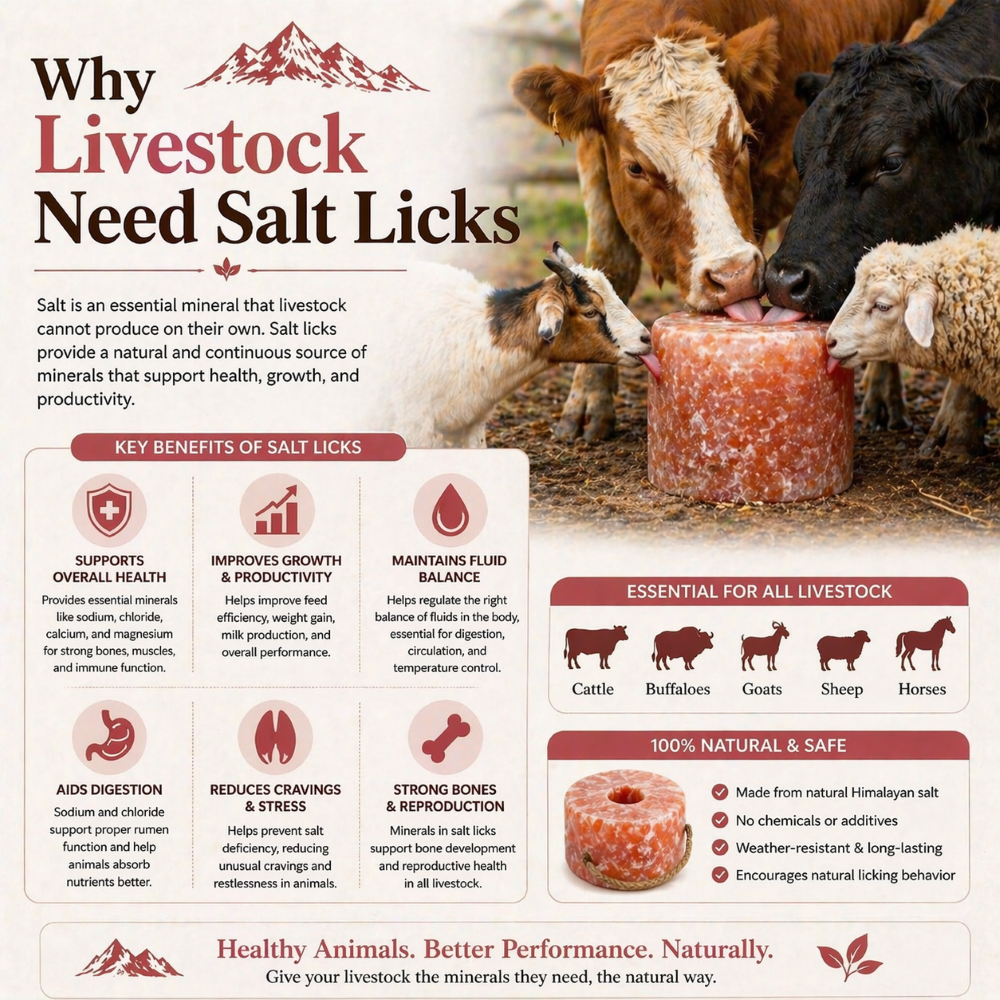
Livestock health depends on more than feed alone. Minerals play a critical role in animal development, productivity, immune strength, and overall well-being, yet they are often overlooked until deficiencies begin to show visible effects. Salt licks are one of the most reliable and natural ways to supply essential minerals to animals in grazing and farming systems. From supporting hydration to improving digestion and reproduction, salt licks fulfill multiple biological needs throughout different life stages. Understanding why livestock require salt licks helps farmers make informed decisions that enhance animal welfare, reduce health risks, improve herd performance, and strengthen long-term farm efficiency and sustainability outcomes.
The biological importance of salt for livestock
Salt is a fundamental nutrient required by all livestock species for survival and proper physiological function. Sodium and chloride, the two primary components of salt, play a vital role in regulating fluid balance, nerve transmission, and muscle contraction. Without adequate salt intake, animals may experience dehydration, reduced appetite, poor digestion, and muscle weakness. Grazing animals, in particular, are prone to salt deficiency because natural forage often lacks sufficient sodium. Soil composition, rainfall, and seasonal variations further reduce mineral availability in pastures. Salt licks provide a consistent and accessible source of sodium that animals instinctively consume based on their biological needs. This self-regulating behavior ensures balanced intake without forcing supplementation. Over time, adequate salt consumption supports stable metabolism, energy utilization, and nutrient absorption. When livestock receive the minerals they need naturally, their overall health improves, reducing stress on the animal and the farmer alike.
Why grazing animals are especially prone to salt deficiency
Grazing livestock rely heavily on pasture-based diets, which often fail to provide sufficient sodium and trace minerals. Most grasses and forage crops contain very low salt levels, particularly in regions with high rainfall where minerals leach from the soil. As animals graze continuously, they deplete their internal sodium reserves, leading to mineral imbalances. These deficiencies may not appear immediately but can gradually affect appetite, weight gain, and immune response. Salt licks act as a corrective measure by supplementing minerals lost through natural grazing. Animals instinctively seek out salt when their bodies signal a deficiency, making salt licks an efficient solution. Without salt access, animals may lick soil, wood, or stones, behaviors that indicate nutritional imbalance and can expose them to parasites or harmful bacteria. Providing salt licks prevents these risks while maintaining healthy grazing behavior.
How salt licks support hydration and water regulation
Hydration is closely linked to salt intake, as sodium helps regulate water absorption and retention in the body. Livestock that lack adequate salt may drink less water, leading to dehydration and reduced feed efficiency. Salt licks stimulate thirst, encouraging animals to drink more water, which is essential for digestion, temperature regulation, and nutrient transport. This is especially important during hot weather or dry seasons when water loss increases due to sweating or panting. Proper hydration improves rumen function in cattle and supports overall metabolic stability. Salt licks ensure animals maintain an optimal water balance without forced intake. By encouraging regular drinking behavior, salt licks help prevent heat stress, fatigue, and reduced productivity. Consistent hydration also improves milk production, growth rates, and overall animal comfort, making salt licks an essential management tool rather than a supplemental luxury.
The role of salt licks in digestion and feed utilization
Salt plays a crucial role in digestion by supporting saliva production and enzyme activity. In ruminant animals such as cattle, sheep, and goats, saliva is essential for maintaining rumen pH and breaking down fibrous feed. Insufficient salt intake can reduce saliva flow, impairing digestion and decreasing feed conversion efficiency. Salt licks encourage natural licking behavior, which stimulates saliva production and supports microbial activity in the rumen. This leads to better nutrient absorption and improved energy utilization from feed. When digestion functions optimally, animals gain weight more consistently and require less feed to maintain health. Over time, improved feed efficiency translates into lower feeding costs and healthier livestock. Salt licks support digestive balance naturally, without the need for synthetic enhancers or complex supplementation programs.
How salt licks contribute to mineral balance
Beyond sodium and chloride, salt licks often provide trace minerals essential for animal health. These minerals support bone development, immune response, reproduction, and enzyme function. Deficiencies in minerals such as magnesium, calcium, or potassium can lead to metabolic disorders, reduced fertility, and weakened immunity. Salt licks act as a delivery system for these minerals, allowing animals to consume them gradually based on need. This self-regulation minimizes the risk of overdose while ensuring consistent intake. Balanced mineral availability supports stable growth, stronger skeletal structure, and better resistance to disease. Over time, animals with access to mineral-rich salt licks exhibit improved vitality and reduced incidence of deficiency-related conditions. This balance is especially important in intensive farming systems where nutritional demands are higher.
Why livestock instinctively seek salt licks
Animals possess natural instincts that guide them toward nutrients their bodies require. When sodium levels drop, livestock actively seek salt sources, often traveling long distances to find them. This instinctive behavior ensures survival in natural environments where mineral access is unpredictable. Salt licks harness this instinct by providing a safe, controlled source of essential minerals. Unlike forced supplementation methods, salt licks allow animals to regulate their intake naturally. This reduces stress and supports behavioral health. Animals with access to salt licks display calmer feeding behavior and are less likely to engage in destructive licking of non-food surfaces. This instinct-driven consumption makes salt licks one of the most efficient and humane mineral supplementation methods available to farmers.
The impact of salt licks on livestock growth and productivity
Consistent access to salt licks positively affects livestock growth rates and productivity. Proper mineral intake supports muscle development, energy metabolism, and hormonal balance. Animals that receive adequate salt show improved appetite, leading to higher feed intake and better weight gain. In dairy animals, salt licks support milk production by maintaining hydration and electrolyte balance. Reproductive performance also improves, as mineral balance plays a role in fertility and calving success. Over time, healthier animals experience fewer illnesses, reducing veterinary costs and losses. Salt licks contribute indirectly to farm profitability by supporting consistent output and minimizing disruptions caused by nutritional deficiencies. This long-term benefit makes salt licks a valuable investment for farms of all sizes.
Salt licks and their role in stress reduction
Stress negatively impacts livestock health, leading to suppressed immunity, reduced appetite, and lower productivity across production systems. Environmental factors such as heat, transport, weather changes, handling, and overcrowding increase stress levels, which in turn raise mineral and hydration requirements. Salt licks help mitigate stress by supporting electrolyte balance, fluid regulation, and proper hydration. Animals with consistent access to salt licks often recover more quickly from physical exertion, heat exposure, and environmental challenges. This stability improves overall comfort and feeding behavior and reduces aggressive behavior within herds. By supporting physiological balance, salt licks help animals adapt to changing conditions with minimal stress. Reduced stress leads to better performance, improved welfare, stronger immunity, and more predictable farm outcomes across diverse livestock systems.
How salt licks support reproduction and fertility
Reproductive health is closely tied to mineral availability across all livestock species and production systems. Sodium and trace minerals influence hormone production, ovulation, metabolic balance, and sperm quality. Livestock lacking adequate salt may experience irregular breeding cycles, reduced conception rates, lower pregnancy success, or weak offspring. Salt licks provide continuous mineral access, supporting reproductive efficiency naturally and consistently throughout the breeding cycle. Improved mineral balance contributes to healthier pregnancies, easier calving, stronger newborns, and improved maternal recovery after birth. Over time, farms that provide salt licks often observe improved breeding outcomes, higher conception rates, and lower reproductive losses. This benefit is particularly important in breeding operations where fertility directly impacts profitability, herd expansion, and long-term farm sustainability. Salt licks serve as a foundational nutritional support for successful livestock reproduction and overall reproductive performance.
Why salt licks are preferred over loose salt
Salt licks offer several advantages over loose salt supplementation in both small-scale and commercial livestock operations. The solid form encourages slow, controlled consumption, reducing waste, spillage, and the risk of overconsumption. Loose salt can be contaminated easily and may dissolve quickly when exposed to moisture, rain, or humidity. Salt licks are durable, weather-resistant, and suitable for outdoor use, making them ideal for grazing systems and open pastures. Animals interact with salt licks naturally, without the need for daily management, weighing, or precise dosing. This convenience reduces labor, improves efficiency, and ensures consistent mineral access. Salt licks also minimize environmental contamination, feed loss, and feeding area mess. Their simplicity, reliability, and long-lasting performance make them a preferred option for modern, sustainable livestock management systems.
Conclusion
Salt licks are a fundamental component of livestock nutrition, supporting hydration, digestion, mineral balance, electrolyte regulation, and overall animal health. By providing a natural, instinct-driven source of essential minerals, salt licks help animals thrive in both grazing and controlled farming systems. Their benefits extend beyond basic nutrition, positively influencing productivity, reproduction, immune strength, and stress management. For farmers seeking a simple yet effective way to improve animal welfare, performance outcomes, and operational efficiency, salt licks remain an indispensable solution. Integrating salt licks into daily livestock management supports long-term sustainability, improved feed utilization, reduced veterinary intervention, and healthier, more productive herds across diverse agricultural environments worldwide.