
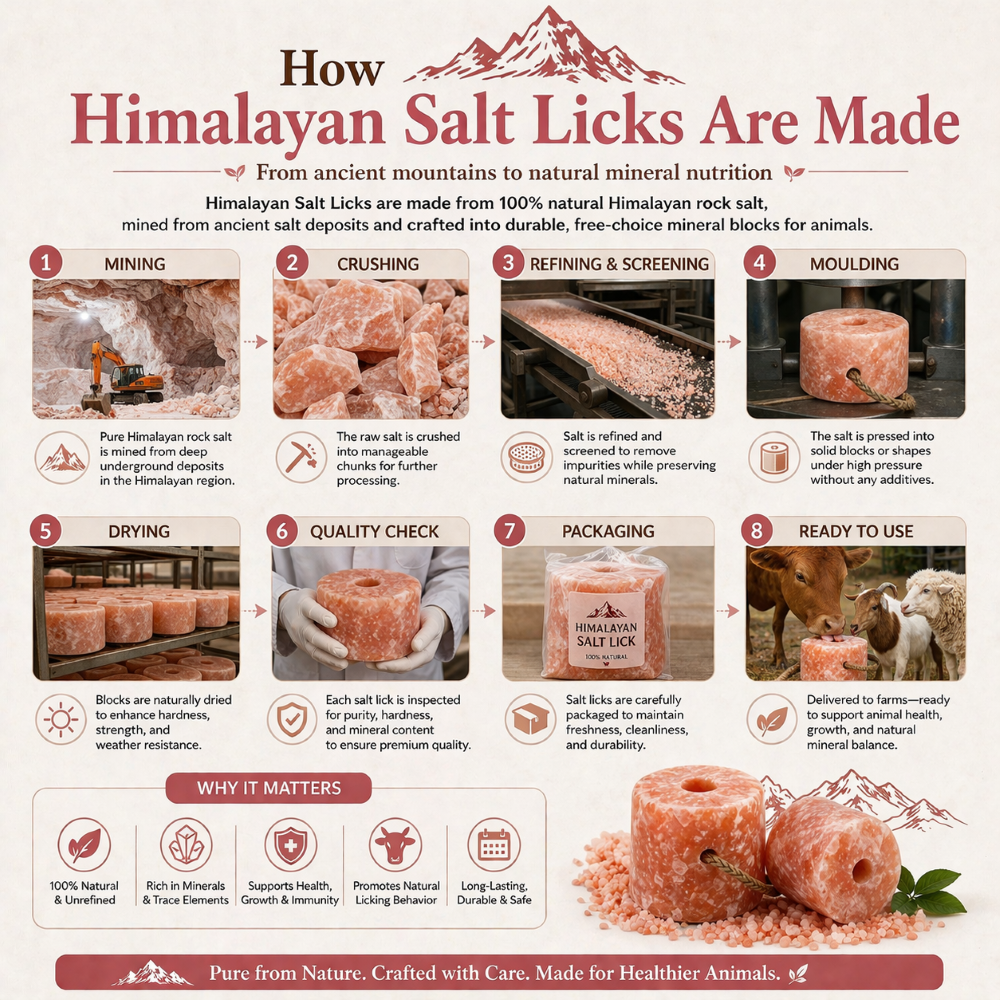
Himalayan salt licks are valued worldwide for their purity, durability, and natural mineral content, but their quality begins long before they reach farms or grazing fields. The process of making Himalayan salt licks involves careful mining, minimal processing, and precise shaping to preserve the salt’s natural structure. Unlike industrial mineral blocks that rely on chemical refinement and compression, Himalayan salt licks are produced using traditional methods that maintain their geological integrity. Understanding how Himalayan salt licks are made helps farmers, buyers, and distributors appreciate their value as a natural animal nutrition solution. This guide explains every stage of production, from extraction in the mountains of Pakistan to final shaping and preparation for use in livestock systems. By exploring the detailed process, buyers and farmers can better evaluate the quality, purity, and effectiveness of Himalayan salt licks compared to other mineral supplements on the market, making more informed decisions for their herds or wildlife programs.
Mining Himalayan rock salt from ancient deposits
The production of Himalayan salt licks begins with mining natural rock salt from ancient deposits located primarily in the Salt Range of Pakistan. These deposits were formed millions of years ago when prehistoric seas evaporated, leaving behind thick layers of mineral-rich salt. Miners extract the salt using controlled blasting and manual cutting techniques that minimize contamination and structural damage. Unlike solution mining, which dissolves salt in water, dry mining preserves the salt’s natural crystalline form. This method ensures the mineral composition remains intact, retaining essential trace elements such as magnesium, calcium, and potassium. The extracted salt appears in large rock chunks of varying sizes, each displaying natural pink, red, or light white tones. Care is taken to avoid areas exposed to pollutants, ensuring purity. This initial stage is critical because the quality of the final salt lick depends entirely on the integrity of the mined rock salt. Skilled miners often have years of experience, as even minor mistakes during extraction can compromise the salt’s structure and reduce the long-term durability of the final licks.
Sorting and selecting raw salt blocks
After extraction, raw Himalayan salt rocks are transported to processing areas where they undergo sorting and selection. Not all mined salt is suitable for animal lick production, as quality, hardness, and mineral consistency vary naturally. Skilled workers inspect each piece visually and manually, selecting dense, solid rocks free from cracks or excessive impurities. This step ensures durability and slow dissolution when animals use the salt lick. Softer or brittle salt may be used for edible or industrial purposes, while stronger blocks are reserved for animal licks. Color variations are natural and accepted, reflecting mineral content rather than defects. Sorting also allows manufacturers to identify salt with the highest levels of trace minerals, which can be important for livestock nutrition. Proper sorting ensures a consistent product that maintains its shape and effectiveness even in outdoor, weather-exposed environments. By carefully selecting the best blocks, manufacturers ensure the salt licks perform reliably in all farm conditions.
Cleaning and preparation of Himalayan salt
Before shaping, selected salt blocks undergo basic cleaning to remove surface dust, loose debris, or soil residue from mining and transport. This process typically involves dry brushing or light washing without chemical agents. The goal is to clean the surface while preserving the natural mineral composition of the salt. Unlike refined salt products, Himalayan salt licks are not dissolved, bleached, or chemically treated. Minimal water exposure ensures that the salt does not weaken or lose hardness. After cleaning, the salt blocks are dried naturally, often using air circulation rather than artificial heat. This preparation stage ensures the salt remains strong, clean, and ready for shaping without compromising its natural structure. In addition, this step helps prevent contamination that could affect the taste or safety for animals. Maintaining purity during this stage is crucial for retaining the health benefits and long-lasting quality of Himalayan salt licks.
Cutting Himalayan salt into workable sizes
Once cleaned, Himalayan salt rocks are cut into manageable sizes suitable for shaping into licks. Large chunks are divided using mechanical saws or traditional cutting tools designed for stone materials. Precision is important to ensure consistent size and weight across salt lick products. Cutting allows manufacturers to create standardized blocks for different livestock needs, ranging from small licks for individual animals to large blocks for herd use. Unlike compressed mineral blocks, Himalayan salt maintains its solid rock form during cutting, which ensures slow and controlled consumption. Cutting also helps remove any weak or fractured sections, improving product safety. Proper sizing makes packaging, transport, and handling easier, especially for farms that require large quantities of salt licks. Standardized blocks also provide uniform mineral intake for livestock, helping maintain consistent nutrition across all animals.
Shaping Himalayan salt licks into blocks
After cutting, salt pieces are shaped into specific forms depending on intended use. Common shapes include square blocks, rectangular slabs, round cylinders, and irregular natural shapes. Shaping is done using grinding or carving tools that smooth edges without altering internal structure. This process ensures the salt lick is safe for animals, reducing sharp edges that could cause injury. The shaping stage also determines how the salt lick will fit into holders, feeding areas, or ground placement. Manufacturers focus on maintaining a balance between shape consistency and natural appearance. Unlike molded salt blocks, Himalayan salt licks retain visible crystal patterns, reinforcing authenticity and natural origin. Proper shaping also increases durability, ensuring the lick can withstand repeated use and environmental exposure. By carefully shaping each piece, manufacturers improve both usability and aesthetic appeal.
Drilling and mounting options for salt licks
Some Himalayan salt licks are carefully drilled to allow secure mounting on rods, ropes, hooks, or specialized holders. Drilling is performed precisely to avoid cracking or damaging the salt, ensuring structural integrity during use. Mounted licks are commonly used in stables, barns, or controlled feeding areas to keep the salt clean, dry, and easily accessible to animals. This installation method reduces contamination from soil, manure, moisture, and environmental debris. Drilling does not involve adhesives, chemicals, or additional processing; it simply creates a central hole for convenient placement. Proper drilling ensures stability, durability, and safe use while allowing animals easy access and self-regulated intake. Mounted Himalayan salt licks are especially popular for horses, indoor livestock systems, small paddocks, and premium farming operations where hygiene, controlled placement, and longevity are critical considerations for daily feeding management.
Natural drying and curing process
After shaping, optional drilling, and surface finishing, Himalayan salt licks undergo a natural drying or curing phase. This step allows any residual moisture from cleaning, cutting, or shaping to evaporate fully. Natural air drying is preferred over artificial heating methods to prevent cracking, weakening, or structural stress in the salt. Proper curing enhances hardness, durability, and longevity, ensuring the salt lick dissolves slowly and consistently when used by animals. This process can take several days or longer depending on local humidity, temperature, and climate conditions. Well-cured salt licks perform better outdoors, resist weather damage, and maintain structural integrity during handling and storage. Drying also stabilizes weight, shape, and appearance, making packaging, shipping, and transport more efficient while preserving quality for end users and buyers.
Quality inspection and durability testing
Before packaging and distribution, Himalayan salt licks undergo thorough quality inspection to ensure consistency, safety, performance, and long-term durability. Inspectors carefully check for cracks, weak spots, uneven shaping, structural flaws, or any imperfections that could affect functionality. Some manufacturers perform basic durability tests, including impact resistance, drop simulations, and moisture exposure checks, to replicate real-world handling and environmental conditions. Only solid, intact, and properly cured blocks are approved for sale, guaranteeing reliable performance for livestock and wildlife. This comprehensive quality control process ensures animals receive a consistent, durable product that lasts longer, dissolves evenly, and performs predictably. High-quality salt licks reduce replacement frequency, minimize waste, improve operational efficiency, and enhance customer satisfaction, particularly in commercial farming, premium livestock operations, and large-scale agricultural supply chains.
Packaging and preparation for transport
Packaging Himalayan salt licks requires careful handling due to their weight, density, and solid structure to prevent breakage or damage. Blocks are typically wrapped in protective materials such as plastic film or foam padding or placed securely in sturdy cartons to prevent chipping during handling and transport. Bulk orders are often palletized, shrink-wrapped, or crate-packed for safe export and long-distance shipping. Packaging focuses primarily on protection rather than preservation, as salt does not spoil, but moisture-resistant materials are sometimes used to prevent surface dampness. Proper labeling includes weight, origin, mineral grade, and usage information. Export-ready and bulk packaging ensures salt licks reach farms, wholesalers, distributors, and international buyers intact, supporting efficient logistics, reduced losses, and consistent product quality across supply chains worldwide.
How Himalayan salt licks differ from processed mineral blocks
The manufacturing process of Himalayan salt licks differs significantly from industrial mineral block production and highly processed feed supplements. Processed blocks are made by refining salt, blending synthetic minerals, and compressing the mixture under high pressure, often with additives or binders. In contrast, Himalayan salt licks remain in their natural rock form throughout production, preserving original mineral content and structure. This difference affects durability, mineral release rate, solubility, and animal preference. Natural salt licks dissolve slowly, allowing animals to self-regulate intake naturally. Their simplicity, purity, and traceable origin appeal to farmers seeking sustainable, chemical-free, and natural nutrition solutions. Understanding this difference highlights why Himalayan salt licks are highly valued in traditional, organic, and sustainable farming systems worldwide.
Conclusion
Himalayan salt licks are made through a careful, natural process that preserves the integrity, mineral richness, and authenticity of ancient rock salt. From mining and sorting to shaping, drilling, and curing, each step focuses on maintaining purity, strength, and balanced mineral content. Unlike chemically processed supplements or synthetic mineral blocks, Himalayan salt licks offer a simple yet highly effective solution for natural animal nutrition. Their production reflects a thoughtful balance between traditional methods and modern quality control, resulting in a durable, natural, and safe product trusted by farmers, breeders, and livestock managers worldwide. Understanding how Himalayan salt licks are made reinforces their long-term value as a sustainable, reliable, and essential mineral supplement across diverse farming systems.