
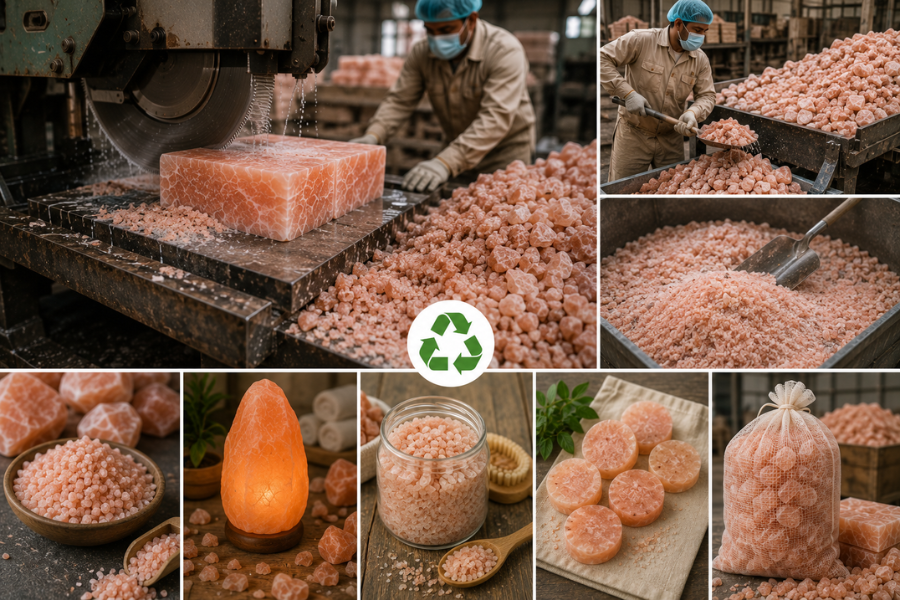
Himalayan salt is one of Pakistan’s most valuable natural resources, supplying international markets with edible salt, decorative products, bath salts, cooking slabs, salt lamps, animal salt licks, and architectural materials. During the manufacturing process, however, not every piece of extracted salt becomes a finished product in its original form. Cutting, shaping, polishing, drilling, and carving naturally produce smaller salt fragments and leftover materials. Rather than treating these pieces as waste, modern Himalayan salt manufacturers have developed efficient methods to reuse them in different product categories. This approach helps reduce unnecessary waste while making better use of valuable natural resources. Sustainable manufacturing practices have become increasingly important because customers and international buyers appreciate companies that minimize environmental impact without compromising product quality. By finding practical applications for leftover salt materials, manufacturers improve production efficiency, reduce costs, and create additional commercial opportunities. Understanding how Himalayan salt waste is reused demonstrates how responsible manufacturing supports both environmental sustainability and long-term business success within the global Himalayan salt industry.
Why Himalayan Salt Waste Is Created During Manufacturing
Although Himalayan salt is carefully extracted and processed, waste materials naturally appear during almost every stage of production. Large salt blocks are cut into smaller sections before being shaped into finished products such as salt lamps, tiles, cooking slabs, candle holders, and decorative pieces. During these operations, small fragments, chips, dust, broken corners, and irregular crystal pieces are separated from the main product. These leftover materials are not defective or lower in quality; they simply do not match the size or shape required for a specific product. Natural variations in the salt crystal also contribute to manufacturing waste because some sections may not be suitable for premium decorative applications. Instead of discarding these remaining materials, manufacturers carefully sort and classify them according to size, color, and potential future use. Modern production facilities recognize that even the smallest salt fragments retain the same natural origin and mineral composition as larger blocks. Through effective material management, manufacturers transform production leftovers into valuable raw materials for many additional Himalayan salt products.
Sustainable Manufacturing Begins with Efficient Material Utilization
One of the most effective ways to improve sustainability in Himalayan salt manufacturing is by maximizing the use of every extracted salt block. Responsible manufacturers carefully plan production processes so that large crystal sections become premium products while smaller remaining pieces are directed toward other manufacturing applications. This approach significantly reduces unnecessary disposal and helps preserve valuable natural resources. Material utilization begins with careful inspection of every salt block before cutting starts. Production teams determine the best possible combination of products that can be created from each piece of raw material, allowing manufacturers to minimize waste from the beginning of the manufacturing process. Larger crystals may become decorative lamps or cooking slabs, and medium-sized sections may be processed into bricks or candle holders, while smaller fragments are collected for edible salt, bath salt, crushed salt, or industrial uses. This systematic production strategy allows companies to achieve greater efficiency while supporting environmentally responsible manufacturing. Better material utilization also improves profitability because more of each mined salt block contributes to finished commercial products.
Converting Small Salt Pieces into Edible Himalayan Salt Products
One of the most common ways manufacturers reuse Himalayan salt waste is by processing smaller crystal fragments into edible salt products. During the production of decorative items, many naturally clean salt pieces remain too small for carving or construction purposes but are still perfectly suitable for food-grade processing after proper cleaning and quality inspection. These crystals are crushed, graded into different particle sizes, and packaged according to customer specifications. Manufacturers produce coarse salt, fine salt, granular salt, seasoning blends, and industrial food ingredients using these recovered materials. Advanced screening equipment separates particles into uniform grain sizes suitable for different culinary applications. Since the original salt comes from the same natural source, the final edible product maintains the same mineral composition and natural appearance. This recycling approach helps manufacturers reduce production waste while supplying growing international demand for Himalayan pink salt in retail, hospitality, food processing, and private-label markets. Efficient reuse supports both environmental responsibility and economic value throughout the manufacturing process.
Reusing Salt Fragments for Himalayan Bath Salt Production
Another highly effective application for leftover Himalayan salt materials is the production of Himalayan bath salt. Decorative manufacturing processes often generate crystal fragments that are ideal for wellness products because they require crushing into different grain sizes rather than maintaining large solid blocks. Manufacturers collect these remaining salt pieces, clean them thoroughly, process them into coarse or fine granules, and prepare them for bath salt packaging. Depending on customer requirements, bath salts may also be blended with essential oils, natural fragrances, herbs, or botanical ingredients before packaging. This production method allows manufacturers to create premium wellness products while making productive use of materials that would otherwise remain unused. Bath salt production represents an excellent example of circular manufacturing because valuable raw materials continue contributing to new commercial products instead of becoming waste. As consumer demand for natural wellness products continues increasing worldwide, reusing Himalayan salt fragments for bath salt manufacturing provides both environmental and commercial benefits while supporting sustainable production practices.
Producing Crushed Himalayan Salt for Decorative and Commercial Applications
Not every remaining piece of Himalayan salt is suitable for food or bath salt production, but many fragments are ideal for creating crushed Himalayan salt used in decorative and commercial applications. Manufacturers collect medium-sized crystal pieces generated during cutting and shaping, then process them into attractive crushed salt in different sizes and color grades. These products are commonly used in decorative bowls, glass containers, interior design projects, spa displays, landscaping features, and wellness centers where natural Himalayan salt adds visual appeal. Crushed salt is also used around salt lamps and decorative arrangements to create attractive presentations for homes, hotels, restaurants, and retail stores. Since customers often request different crystal sizes and color combinations, manufacturers sort crushed salt carefully before packaging. This approach allows even relatively small production leftovers to become valuable commercial products. By transforming leftover salt into decorative materials, manufacturers maximize resource utilization while expanding their product range. The growing popularity of natural home décor continues to create new opportunities for crushed Himalayan salt in domestic and international markets.
Using Leftover Salt in Animal Salt Lick Manufacturing
Animal salt licks provide another excellent opportunity for manufacturers to reuse suitable Himalayan salt materials generated during production. Although premium decorative products require large, flawless salt blocks, many medium-sized pieces remain structurally strong and perfectly suitable for agricultural applications. Manufacturers combine carefully selected salt fragments or reshape solid leftover pieces into livestock salt licks used for cattle, goats, sheep, horses, and other farm animals. Depending on customer requirements, these products may be produced in round, square, rectangular, or customized forms before packaging for domestic and export markets. Since animal salt licks do not require the same decorative appearance as premium home décor products, manufacturers can effectively utilize salt pieces that would otherwise remain unused. Quality inspection remains important because only clean and structurally sound material is selected for livestock applications. This manufacturing approach helps reduce waste while supplying farmers with practical mineral products. Reusing suitable leftover salt for agricultural purposes demonstrates how manufacturers successfully match different raw material grades with appropriate commercial applications throughout the production process.
Reusing Salt Dust and Fine Particles
Even the smallest materials generated during Himalayan salt manufacturing can often be reused instead of discarded. Cutting, drilling, polishing, and grinding naturally produce fine salt particles and dust that accumulate throughout production facilities. Responsible manufacturers collect these materials carefully using specialized equipment designed to keep production areas clean while recovering valuable natural salt. After appropriate quality inspection and cleaning procedures, fine salt particles may be processed for industrial applications, certain cleaning products, or additional manufacturing processes where extremely fine grain sizes are required. Some manufacturers also blend recovered salt particles with larger crushed materials to produce products requiring mixed crystal textures. Effective collection systems help reduce production waste while improving workplace cleanliness and operational efficiency. Although salt dust represents one of the smallest by-products of manufacturing, recovering these materials demonstrates the industry’s commitment to maximizing resource utilization. Every stage of production contributes to sustainable manufacturing when leftover materials are managed responsibly rather than simply discarded after processing.
Environmental Benefits of Reusing Himalayan Salt Waste
Reusing Himalayan salt waste offers important environmental benefits that extend beyond manufacturing efficiency. Every piece of salt successfully transformed into another commercial product reduces unnecessary disposal and encourages responsible use of natural resources. Since Himalayan salt is extracted from ancient underground deposits, maximizing material utilization helps ensure that mining activities produce greater value from every extracted block. Efficient reuse also decreases the amount of waste requiring storage or disposal, creating cleaner production facilities and reducing the environmental footprint of manufacturing operations. Modern buyers increasingly appreciate companies that demonstrate sustainable production practices because environmental responsibility has become an important consideration in international trade. Manufacturers that recover leftover salt for edible products, bath salts, decorative applications, or livestock products contribute to circular production systems where resources remain in continuous use for as long as possible. These environmentally responsible practices strengthen both business reputation and customer confidence while supporting long-term sustainability within the Himalayan salt industry. Responsible manufacturing benefits producers, buyers, and the environment simultaneously.
Economic Advantages of Material Recycling
Recycling Himalayan salt waste is not only environmentally beneficial but also economically valuable for manufacturers and international buyers. Every additional product created from leftover materials increases the overall value generated from each mined salt block. Instead of treating production leftovers as waste, manufacturers convert them into marketable products that generate additional revenue while lowering overall production costs. Improved material utilization helps businesses reduce raw material losses, increase profitability, and remain competitive in international markets. Companies offering a wide variety of Himalayan salt products also benefit because recovered materials support multiple product categories without requiring additional mining. These efficiencies allow manufacturers to invest in improved equipment, quality control systems, and sustainable production technologies. Buyers also benefit because efficient manufacturing helps maintain competitive pricing while preserving consistent product quality. As global demand continues increasing, companies that successfully recycle production materials strengthen their long-term financial performance while demonstrating responsible resource management. Economic sustainability and environmental sustainability work together to support continued growth within the Himalayan salt manufacturing industry.
Innovation and the Future of Sustainable Salt Manufacturing
The Himalayan salt industry continues evolving as manufacturers adopt new technologies and production methods that further improve resource efficiency. Modern cutting equipment, digital production planning, precision measuring systems, and automated sorting technologies help manufacturers reduce unnecessary waste before it is even created. At the same time, researchers and production specialists continue exploring new commercial applications for smaller salt fragments and by-products generated during manufacturing. Improved packaging materials, advanced moisture-control systems, and environmentally friendly production processes are also contributing to more sustainable manufacturing operations. Customer demand for responsibly produced natural products encourages manufacturers to invest in innovation while preserving traditional craftsmanship and product authenticity. Companies that successfully combine technological improvements with careful resource management are likely to remain competitive in global markets. Sustainable manufacturing is no longer viewed simply as an environmental objective but as an important business strategy that improves efficiency, customer confidence, and long-term profitability. Continued innovation ensures that Himalayan salt manufacturing becomes even more efficient while protecting valuable natural resources for future generations.
Why Responsible Manufacturers Focus on Zero-Waste Production
Many leading Himalayan salt manufacturers are working toward production systems that aim to use as much of the extracted salt as possible. Although achieving complete zero waste can be challenging, careful planning allows manufacturers to ensure that nearly every portion of the mined salt contributes to a finished product. Large crystal blocks become decorative items, medium-sized pieces are transformed into cooking slabs or animal salt licks, smaller fragments are processed into bath salts or edible salt, and even fine particles can often be recovered for suitable industrial applications. This integrated manufacturing approach demonstrates responsible resource management while reducing unnecessary material losses. Buyers increasingly recognize the importance of working with suppliers that prioritize sustainability because responsible production reflects both environmental awareness and operational excellence. Manufacturers committed to efficient material utilization also tend to maintain stronger quality control systems, better production planning, and more consistent product standards. Zero-waste thinking represents an important direction for the future of Himalayan salt manufacturing as global markets continue demanding sustainable and environmentally responsible products.
Conclusion
The reuse of Himalayan salt waste demonstrates how modern manufacturing can successfully combine environmental responsibility with commercial efficiency. Throughout the production process, leftover materials generated during cutting, shaping, polishing, and finishing are carefully sorted and transformed into valuable new products instead of being discarded. Small crystal fragments become edible Himalayan salt, bath salts, crushed decorative salt, animal salt licks, and various industrial products, allowing manufacturers to maximize the value of every mined salt block. This sustainable approach reduces waste, supports responsible resource management, improves production efficiency, and creates additional business opportunities for manufacturers and exporters. As international customers continue seeking authentic natural products produced through environmentally responsible methods, sustainable manufacturing practices become even more important. Companies that invest in efficient material utilization, innovative recycling methods, and continuous production improvements strengthen both their environmental reputation and long-term business success. By reusing Himalayan salt waste in practical and creative ways, manufacturers ensure that this remarkable natural resource continues delivering value to customers around the world while supporting a more sustainable future for the industry.