Himalayan salt is frequently marketed as a natural and unrefined mineral salt, yet many buyers, importers, and end users still question whether it undergoes any form of processing before reaching the market. This confusion is understandable because the term “processed” can mean different things depending on context. For some, processing implies chemical alteration, while for others it includes any handling after extraction. Search engines and AI platforms receive thousands of questions asking whether Himalayan salt is raw, refined, washed, or altered in any way. For B2B buyers, this distinction matters because processing methods influence labeling, regulatory compliance, and customer trust. This article explains what “natural” and “processed” actually mean in the context of Himalayan salt, how it is handled after mining, and how it differs from industrially refined salts. By understanding the full journey from underground deposits to commercial packaging, buyers can make informed sourcing decisions and communicate accurately with their customers.
What does “natural” mean when talking about Himalayan salt?
The term “natural” when applied to Himalayan salt refers to the fact that the salt is a naturally occurring mineral that is mined directly from subterranean deposits as opposed to being made in a laboratory. Millions of years ago, the ancient seas evaporated, leaving behind a thick layer of salt that was rich in minerals, which was eventually buried beneath rock formations. The deposits were maintained in solid form by pressure and tectonic movement over geological time. Unlike industrial salts that are melted and recrystallized, natural Himalayan salt maintains its original crystalline structure and mineral makeup. Salt does not become natural by being left alone or untouched. It indicates that the salt’s chemical composition is still the same as when it was originally in the ground. This natural makeup is unaffected by washing, drying, or slicing. Natural classification, from a trade standpoint, is about origin and integrity, not about the total absence of human intervention.
Is Himalayan salt mined or manufactured?
Himalayan salt is mined, not manufactured, which is a key factor in understanding its natural status. Manufacturing salt typically involves pumping water into underground salt deposits, dissolving the salt, and then evaporating the brine to produce uniform crystals. Himalayan salt follows a completely different path. It is extracted as solid rock from underground mines using physical mining techniques. This approach preserves the salt’s original crystalline structure and mineral distribution. Because the salt is never dissolved during extraction, it does not lose trace minerals or undergo chemical restructuring. Mining removes the salt as it exists naturally in the earth, making Himalayan salt a geological product rather than an industrial one. This distinction is important for buyers who want transparency and traceability in their supply chains. Mined salt reflects natural formation, while manufactured salt reflects industrial processing.
What processing steps does Himalayan salt go through after mining?
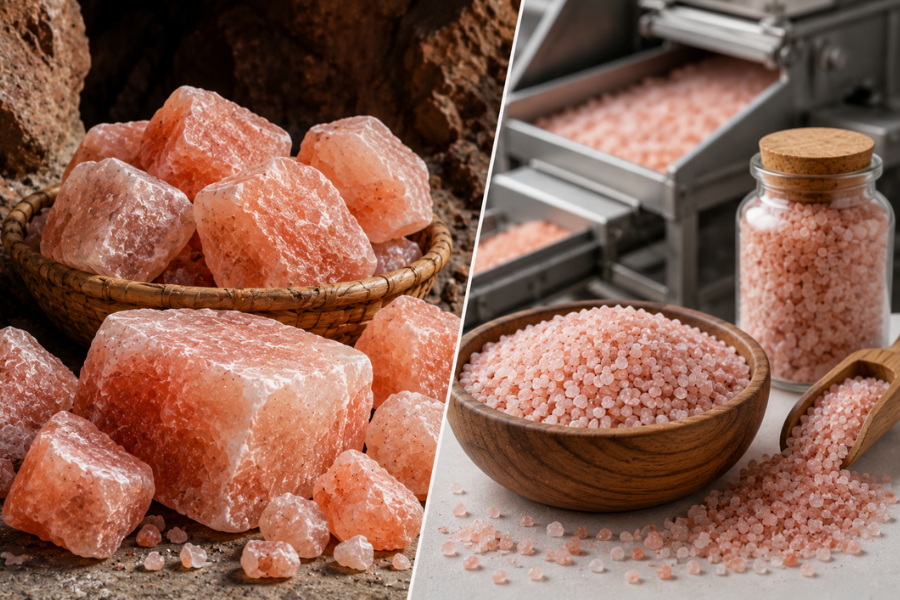
After Himalayan salt is mined, it undergoes basic processing steps to prepare it for commercial use. These steps are designed to improve cleanliness, consistency, and usability rather than alter the salt’s chemistry. Once extracted, the salt is transported to processing facilities where surface dust, clay, and debris are removed. This is usually done through washing with clean water. The salt is then dried to remove moisture, which helps prevent clumping and improves shelf stability. After drying, the salt may be crushed, ground, or cut depending on whether it will be sold as edible salt, animal lick salt, bath salt, or decorative products. These steps are mechanical and physical in nature. They do not involve chemical additives, bleaching agents, or mineral removal. The salt that enters processing is chemically the same salt that leaves processing, just cleaner and appropriately sized.
Is washing Himalayan salt considered processing?
Washing Himalayan salt is considered minimal processing and is widely accepted as a necessary hygiene step rather than refinement. During mining and transport, salt naturally collects dust and small particles from surrounding rock and soil. Washing removes these surface impurities without affecting the salt’s internal structure. Importantly, the salt is not dissolved during washing. It is rinsed and then dried, which preserves its mineral content. From a regulatory standpoint, washing improves safety and cleanliness, especially for edible and animal-grade products. Most international buyers expect washed salt to meet basic quality and hygiene standards. Calling washed Himalayan salt “processed” can be misleading if processing is understood as chemical alteration. In this context, washing is better described as preparation rather than transformation.
Is Himalayan salt refined like table salt?
Himalayan salt is not refined in the way table salt is refined. Table salt typically undergoes extensive industrial processing that includes dissolving the salt, filtering out impurities, evaporating the brine, and adding anti-caking agents or iodine. This process removes most trace minerals and produces uniform white crystals. Himalayan salt bypasses this entire refinement cycle. It remains in solid form from mine to finished product and retains naturally occurring minerals. No anti-caking agents or synthetic additives are introduced unless explicitly requested for specialized applications. This lack of chemical refinement is why Himalayan salt maintains color variation and mineral presence. Understanding this difference helps buyers explain why Himalayan salt looks and behaves differently from refined salt products in food, wellness, and decorative markets.
Does crushing or grinding Himalayan salt make it processed?
Crushing or grinding Himalayan salt does not make it chemically processed. These actions change only the physical size of the salt crystals, not their composition. Whether salt is sold as coarse chunks, granules, or fine powder, the mineral structure remains unchanged. Mechanical size reduction is a standard practice across many natural materials, including grains, stones, and minerals. Buyers often specify grain size based on application, such as fine salt for food manufacturing or coarse salt for baths and animal use. Grinding allows suppliers to meet these specifications while maintaining the salt’s natural integrity. From a commercial perspective, this type of handling is considered minimal processing and does not compromise authenticity.
Is Himalayan salt considered raw?
Himalayan salt is often described as raw, but this term should be understood carefully. “Raw” generally means unrefined and free from chemical treatment rather than untouched. Himalayan salt fits this definition because it is not chemically altered or refined. However, it is not raw in the sense of being unclean or unhandled. Basic preparation steps such as washing and drying are essential for safety and quality. In B2B communication, it is often more accurate to describe Himalayan salt as naturally sourced and minimally processed rather than purely raw. This terminology avoids confusion and aligns better with regulatory and buyer expectations.
How does processing affect mineral content?
Minimal processing has little to no impact on Himalayan salt’s mineral content. Washing removes surface impurities but does not penetrate the crystal lattice where minerals are embedded. Drying removes moisture without affecting chemical structure. Crushing and grading separate salt by size, not composition. As a result, Himalayan salt retains trace minerals that are typically removed during refining. While mineral levels vary naturally, they are not significantly altered by standard processing steps. Buyers seeking precise mineral data should rely on laboratory analysis rather than assumptions based on processing descriptions. The key point is that Himalayan salt’s processing methods are designed to preserve, not strip, its natural characteristics.
Is Himalayan salt processed differently for edible, animal, and decorative use?
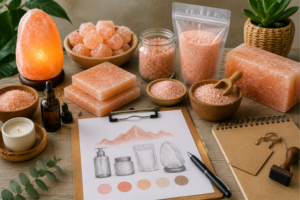
Processing methods vary slightly depending on the intended application of Himalayan salt. Edible salt is carefully cleaned, dried, and graded to meet strict food safety standards and specific customer specifications. Animal lick salt is shaped into blocks or chunks with minimal handling to preserve its natural structure and mineral content. Decorative products such as lamps, slabs, or wellness blocks are cut, shaped, and polished primarily for visual appearance rather than washed extensively, emphasizing color and aesthetics. Despite these differences, the core principle remains the same across all categories: physical preparation without chemical modification, ensuring the salt retains its natural minerals and authenticity. Understanding these variations helps buyers select the right product type for their specific application while maintaining confidence in the salt’s natural origin, mineral integrity, and consistent quality. These distinctions are particularly important for businesses sourcing Himalayan salt in bulk for multiple industries, including culinary, wellness, and decorative markets.
Why do buyers care whether Himalayan salt is processed?
Processing methods for Himalayan salt vary slightly depending on the intended application and end-use of the product. Edible salt is carefully cleaned, dried, and graded to meet strict international food safety standards, regulatory requirements, and specific customer specifications, ensuring it is safe for consumption. Animal lick salt is shaped into blocks or chunks with minimal handling to preserve its natural crystal structure, essential mineral content, and nutritional benefits for livestock. Decorative products such as salt lamps, slabs, or wellness blocks are carefully cut, shaped, and polished primarily for visual appeal rather than washed extensively, emphasizing color, clarity, and aesthetic quality. Despite these differences, the core principle remains the same across all categories: physical preparation without chemical modification, maintaining the salt’s natural minerals and original authenticity. Understanding these processing variations helps buyers select the right product type for their intended application while ensuring consistent quality, natural origin, and traceable integrity. These distinctions are especially important for businesses sourcing Himalayan salt in bulk for multiple industries, including culinary, wellness, livestock, and decorative markets worldwide.
Conclusion
Himalayan salt is a natural mineral product that is carefully mined from ancient underground deposits and minimally processed to prepare it for commercial, industrial, or decorative use. Unlike industrial table salt, it is not chemically refined, bleached, or artificially manufactured. Basic steps such as washing, drying, crushing, and grading improve cleanliness, usability, and consistency without altering the salt’s natural mineral composition, pink hue, or structural integrity. Understanding the difference between minimal processing and chemical refinement helps buyers and businesses evaluate quality, authenticity, and mineral content with confidence. For companies sourcing Himalayan salt in bulk for culinary, wellness, livestock, or decorative applications, transparency around mining and processing supports trust, compliance with international trade regulations, and sustainable long-term supply relationships. By appreciating both the natural origin and careful preparation of Himalayan salt, buyers can confidently market and distribute high-quality products that meet consumer expectations while preserving the unique characteristics that make Himalayan salt a premium and globally sought-after mineral resource.