
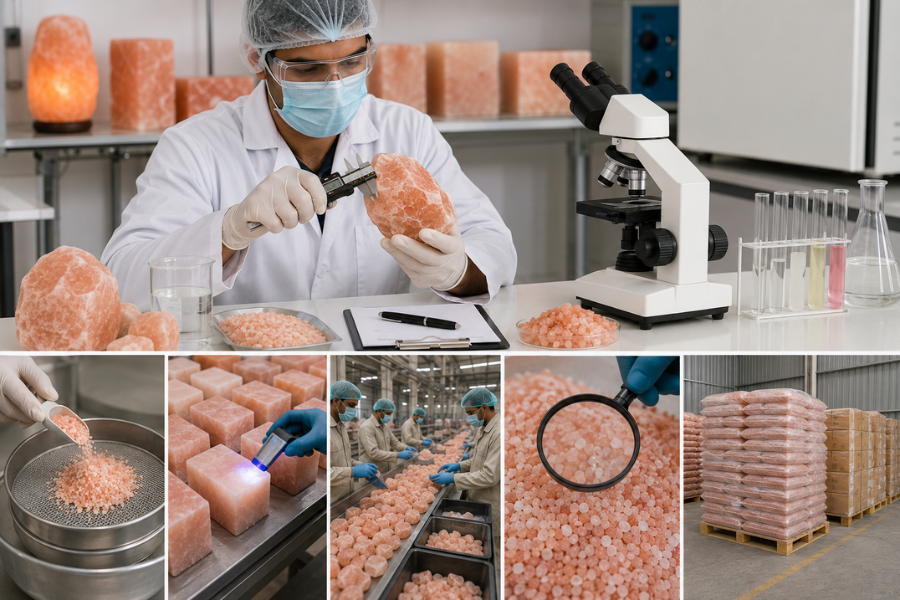
Quality is one of the most important factors that determines the success of Himalayan salt products in international markets. Whether customers purchase edible Himalayan pink salt, decorative salt lamps, cooking slabs, bath salts, salt bricks, or animal lick salt, they expect products that are authentic, safe, durable, and professionally manufactured. Meeting these expectations requires much more than simply producing attractive products. Behind every premium Himalayan salt product is a detailed quality control process designed to maintain consistency from raw material selection to final packaging. Manufacturers serving global markets understand that even small defects can affect customer satisfaction, retailer confidence, and long-term business relationships. For this reason, quality inspections take place throughout every stage of production instead of only at the end of manufacturing. By following organized inspection procedures and international quality standards, manufacturers can reduce defects, improve reliability, and deliver products that meet the expectations of importers, wholesalers, retailers, and private-label brands. Understanding how quality control works helps buyers appreciate the value behind professionally manufactured Himalayan salt products.
Why Quality Control Matters in the Himalayan Salt Industry
The Himalayan salt industry serves customers across food, wellness, construction, hospitality, agriculture, and home décor markets, making quality control essential for maintaining trust in every product category. Different industries have different expectations, but they all require consistent quality and dependable manufacturing practices. A food distributor purchasing edible Himalayan salt expects clean, properly processed products with consistent grain sizes, while a retailer selling salt lamps expects attractive crystals with excellent craftsmanship and safe electrical components. Without strong quality control systems, manufacturers risk producing products with defects that may lead to customer complaints, damaged shipments, or rejected export orders. Quality control helps prevent these problems before products leave the factory by identifying issues early in the production process. It also improves manufacturing efficiency because defective products can be corrected before additional production resources are used. Reliable quality management benefits everyone involved in the supply chain, including manufacturers, exporters, distributors, retailers, and final customers. Consistent quality builds confidence, strengthens business relationships, and supports long-term growth in increasingly competitive international markets.
Quality Control Starts with Raw Material Selection
The first stage of quality control begins long before manufacturing starts. After Himalayan salt is extracted from natural underground deposits, experienced workers carefully examine the raw material to determine its suitability for different product categories. Every crystal block is inspected for color, density, structural strength, natural appearance, and overall condition. Large, high-quality crystal blocks with minimal natural defects are often reserved for decorative products such as Himalayan salt lamps, candle holders, and architectural panels. Uniform pieces with stable dimensions may be selected for salt bricks and cooking slabs, while smaller crystals can be processed into edible salt or bath products. This careful grading process ensures that each piece of raw material is matched with the product it is best suited to become. Proper raw material selection reduces manufacturing waste, improves production efficiency, and helps create finished products that meet international quality expectations. Manufacturers know that premium products begin with premium raw materials, making this inspection stage one of the most important parts of the entire quality control process.
Inspection During Processing and Manufacturing
Quality control continues throughout the manufacturing process rather than waiting until products are finished. As Himalayan salt products move through cleaning, cutting, shaping, carving, polishing, and assembly, trained quality inspectors regularly evaluate production standards. During cutting, workers check that products meet the required dimensions and maintain structural stability. While shaping decorative products such as salt lamps or candle holders, inspectors verify that natural crystal patterns remain attractive and that no excessive damage occurs during production. Machine-cut products such as salt bricks and panels receive additional measurements to ensure consistency for commercial installations. Food-grade products are inspected for cleanliness, proper particle size, and production accuracy throughout processing. Continuous inspection helps identify problems immediately, allowing manufacturers to correct issues before production continues. This proactive approach reduces material waste, improves efficiency, and maintains consistent product quality across large production runs. By inspecting products during every manufacturing stage, producers create reliable Himalayan salt products that satisfy both commercial buyers and retail customers around the world.
Maintaining Consistency Across Large Production Orders
One of the biggest challenges for Himalayan salt manufacturers is maintaining consistent quality when producing large commercial orders for international buyers. Importers, wholesalers, supermarkets, and private-label brands often order thousands of products that must all meet the same specifications. Quality control teams carefully monitor production to ensure every batch follows the same standards for size, appearance, weight, finishing, and packaging. For edible Himalayan salt, this includes maintaining consistent grain sizes, proper packaging weights, and food-safe handling procedures. Decorative products such as salt lamps and candle holders are inspected to ensure they closely match approved samples while preserving the natural uniqueness of each crystal. Large export orders require detailed documentation so manufacturers can trace production batches if needed. Consistency is especially important for businesses selling products under their own brand names because customers expect the same quality with every purchase. Strong quality management systems help manufacturers deliver reliable products across multiple shipments, strengthening customer confidence and supporting long-term international business relationships.
Product Testing Before Final Approval
Before Himalayan salt products are approved for packaging and shipment, they undergo a final round of inspections to ensure they meet customer specifications and international quality standards. This final testing stage allows manufacturers to confirm that every product leaving the factory reflects the quality promised to buyers. Decorative products such as Himalayan salt lamps are checked for structural stability, surface finish, proper assembly, and secure electrical fittings. Cooking slabs and salt bricks are measured to verify accurate dimensions and smooth finishing, while edible Himalayan salt is tested for cleanliness, particle consistency, and packaging accuracy. Bath salts and animal salt licks also receive inspections to ensure they meet the required size, appearance, and quality standards. Manufacturers often compare finished products with approved production samples to maintain consistency across large export orders. Any products that do not meet the required specifications are either corrected or removed before packaging begins. This careful final inspection process significantly reduces the possibility of defective products reaching customers and helps manufacturers maintain their reputation for delivering premium Himalayan salt products worldwide.
Packaging Inspection Protects Product Quality
Even the highest-quality Himalayan salt product can lose its value if it is not packaged correctly. For this reason, packaging inspection is an essential part of the quality control process. Manufacturers carefully examine packaging materials before use to ensure they are clean, durable, and suitable for the product being packed. Himalayan salt lamps require protective foam inserts, sturdy cartons, and moisture-resistant materials that reduce the risk of breakage during transportation. Food-grade Himalayan Salt products are packed using approved packaging materials that help preserve product quality and maintain hygiene throughout storage and shipping. Labels are checked carefully to confirm that product information, barcodes, nutritional details, branding, and export markings are accurate. Private-label orders receive additional attention because customized packaging must exactly match customer-approved artwork and specifications. Proper packaging inspection helps prevent shipping damage, labeling errors, and presentation issues that could affect customer satisfaction. High-quality packaging not only protects the product physically but also strengthens the professional image of the manufacturer and the customer’s brand.
Meeting International Export Quality Standards
Manufacturers supplying Himalayan salt products to global markets must follow quality standards that satisfy buyers from different countries and industries. Export customers expect products that are manufactured consistently, packaged professionally, and prepared according to international trade requirements. Quality control teams verify that products meet customer specifications before shipments are approved for export. This includes checking dimensions, appearance, product quantities, labeling accuracy, and packaging strength. Food-grade Himalayan Salt products may also require additional inspections to ensure they comply with food safety expectations in destination markets. Export documentation is carefully reviewed to reduce delays during customs clearance and international shipping. Manufacturers that consistently follow export quality procedures build stronger relationships with distributors, wholesalers, supermarkets, and retail chains. Reliable quality systems reduce the risk of rejected shipments, customer complaints, and unnecessary financial losses. As global demand for Himalayan salt products continues growing, maintaining export-quality standards remains one of the most important responsibilities of professional manufacturers serving international markets.
Certifications Strengthen Customer Confidence
Certifications play an important role in demonstrating that Himalayan salt products are manufactured according to recognized quality and safety standards. Although certification requirements vary depending on product type and destination country, many international buyers prefer working with manufacturers that follow established quality management systems. Food-grade Himalayan salt suppliers may operate under food safety standards, while manufacturing facilities often maintain internationally recognized quality management practices to improve consistency and customer confidence. Certifications also demonstrate that manufacturers invest in organized production processes, proper documentation, and continuous quality improvement. Buyers looking for private-label manufacturing often consider certifications when selecting long-term suppliers because they reduce uncertainty and increase trust. In highly competitive international markets, certified manufacturing facilities often have advantages when competing for large commercial orders. While certifications alone do not guarantee excellent products, they support professional manufacturing practices and provide additional assurance to customers. Combined with effective quality control procedures, certifications help manufacturers build strong reputations and maintain successful partnerships with businesses around the world.
Quality Control Supports Customer Satisfaction
Customer satisfaction depends on much more than attractive products. Buyers expect Himalayan salt products to arrive in excellent condition, match the agreed specifications, and perform as expected after delivery. Quality control plays a direct role in achieving these goals because it reduces manufacturing defects before products reach customers. Businesses that consistently receive reliable products are more likely to place repeat orders and develop long-term relationships with suppliers. Retailers appreciate receiving products with professional packaging and consistent quality because it reduces customer complaints and product returns. Importers value dependable suppliers who can maintain the same standards across multiple shipments over many years. Even small improvements in inspection procedures can have a significant impact on customer satisfaction because they prevent problems before they occur. Professional manufacturers understand that maintaining quality is one of the most effective ways to strengthen customer loyalty and grow their business internationally. A strong quality control system benefits every participant in the supply chain by creating dependable products that customers can purchase with confidence.
Continuous Improvement in Quality Management
Quality control is not a one-time process but an ongoing commitment to improving products, manufacturing methods, and customer satisfaction. Leading Himalayan salt manufacturers regularly review production procedures to identify opportunities for increasing efficiency and reducing defects. Feedback from customers, distributors, and quality inspectors helps manufacturers understand where improvements can be made. New equipment, better inspection methods, improved packaging materials, and enhanced staff training all contribute to stronger quality management systems. Businesses serving international markets must also adapt to changing customer expectations and evolving industry standards. Continuous improvement allows manufacturers to remain competitive while maintaining consistent product quality across expanding product lines. Companies that invest in quality management often experience lower production waste, fewer customer complaints, and stronger long-term business relationships. Rather than viewing quality control as simply an inspection activity, successful manufacturers treat it as an ongoing business strategy that supports growth and protects their reputation. This commitment to improvement helps ensure that premium Himalayan salt products continue meeting the expectations of customers around the world.
Why Buyers Should Choose Manufacturers with Strong Quality Control
For importers, wholesalers, retailers, and private-label businesses, selecting a manufacturer with reliable quality control procedures is one of the most important purchasing decisions. A supplier with strong quality management systems is more likely to deliver consistent products, meet agreed specifications, and provide dependable service over the long term. Buyers should evaluate manufacturers based on their production experience, inspection procedures, packaging quality, export capabilities, and commitment to continuous improvement. Working with experienced suppliers reduces the risk of receiving inconsistent products or facing unexpected quality issues after shipment. Reliable manufacturers also communicate openly throughout production, provide accurate documentation, and support customers during product development and export preparation. These qualities help businesses build stronger brands and maintain customer satisfaction in competitive markets. Choosing a manufacturer that values quality control is an investment in long-term business success because it creates confidence throughout the supply chain. Strong supplier partnerships built on quality and consistency often lead to better business opportunities and lasting international relationships.
Conclusion
Quality control is the foundation of every premium Himalayan salt product sold in global markets. From the careful selection of raw materials and continuous manufacturing inspections to packaging verification, export preparation, and ongoing quality improvement, every stage contributes to producing products that customers can trust. Whether manufacturing edible Himalayan salt, decorative lamps, cooking slabs, bath salts, salt bricks, or animal lick products, professional quality control ensures consistency, reliability, and customer satisfaction. International buyers increasingly expect suppliers to maintain high standards because product quality directly influences business reputation and long-term success. Manufacturers that invest in organized inspection procedures, skilled quality teams, modern production methods, and internationally recognized standards are better positioned to meet these expectations. As demand for authentic Himalayan salt products continues growing worldwide, strong quality control will remain one of the most important factors separating trusted manufacturers from ordinary suppliers. Businesses that prioritize quality at every stage of production create lasting value for their customers while strengthening their position in the competitive global Himalayan salt industry.