
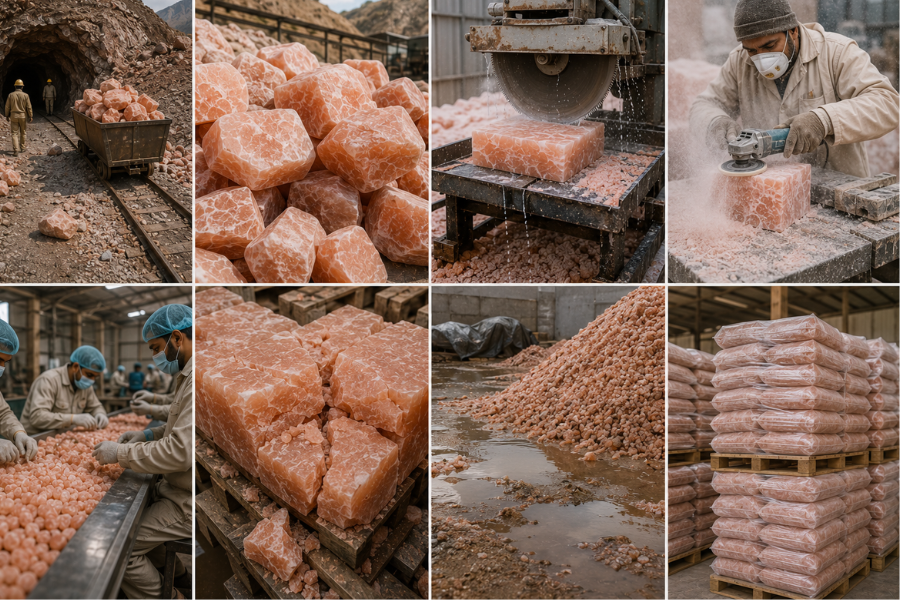
The Himalayan salt industry has grown into one of Pakistan’s most recognized export sectors, supplying natural salt products to customers across the world. From edible pink salt and bath salts to salt lamps, cooking slabs, decorative tiles, and animal salt licks, manufacturers serve a wide range of industries that demand high-quality natural products. Although Himalayan salt is known for its beauty and natural origin, producing finished products is not always a simple process. Manufacturers face several challenges that begin deep inside the salt mines and continue throughout processing, shaping, quality inspection, packaging, and international shipping. Every stage requires careful attention because even small production issues can affect product quality, customer satisfaction, and export performance. As global demand continues increasing, manufacturers must improve efficiency while preserving the natural characteristics that make Himalayan salt unique. Understanding these manufacturing challenges helps buyers appreciate the effort involved in producing premium Himalayan salt products while helping businesses identify reliable suppliers capable of maintaining consistent quality standards throughout the production process.
Mining Natural Himalayan Salt Without Damaging the Crystal Structure
One of the first manufacturing challenges begins during the mining process itself. Himalayan salt is extracted from ancient underground deposits where large salt formations have remained protected for millions of years. Although mining technology has improved over time, workers still need to remove salt blocks carefully to preserve their natural crystal structure. Excessive force or improper extraction techniques can create cracks, fractures, or damaged sections that reduce the value of the raw material. Large crystal blocks intended for premium products such as salt lamps, cooking slabs, and decorative panels require especially careful handling because these products depend on strong, solid pieces of natural salt. Manufacturers must balance production efficiency with careful extraction practices to minimize waste while maintaining product quality. Since each salt deposit contains natural variations in color, density, and crystal formation, selecting suitable raw materials for different products requires experienced workers who understand the characteristics of Himalayan salt. Proper mining practices establish the foundation for every product manufactured later in the production process.
Managing Natural Variations in Color and Crystal Quality
Unlike artificial building materials or manufactured decorative products, Himalayan salt is a completely natural resource. This means every block of salt is slightly different in appearance, color, transparency, and mineral patterns. While these natural variations are one of the reasons customers appreciate authentic Himalayan salt, they also create manufacturing challenges for producers supplying international buyers. Customers often request products with consistent color ranges, especially for decorative applications such as salt lamps, tiles, bricks, and panels. Manufacturers therefore spend significant time sorting raw materials into different quality grades before production begins. Deep pink, light pink, orange, white, and mixed-color crystals may all be separated according to customer specifications. This grading process requires skilled workers who understand product requirements and international quality expectations. Maintaining consistency across large export orders can become particularly challenging because no two natural salt crystals are exactly alike. Manufacturers must carefully balance customer expectations for uniformity while preserving the authentic appearance that makes Himalayan salt naturally attractive.
Cutting Himalayan Salt Into Precise Shapes Without Breakage
Transforming large Himalayan salt blocks into finished products requires precision-cutting equipment and experienced craftsmen. Unlike ordinary stone, Himalayan salt is a natural mineral that must be processed carefully to prevent unnecessary breakage. Manufacturing products such as cookisaltlabs, salt bricks, tiles, candle holders, and decorative panels requires accurate cutting according to customer specifications. Even slight mistakes during cutting may produce cracks or uneven surfaces that reduce product quality. Custom orders create additional challenges because buyers frequently request non-standard dimensions, special shapes, or unique product designs. Manufacturers must carefully measure, cut, and inspect every piece before moving it to the next production stage. Cutting equipment also requires regular maintenance to achieve clean edges while minimizing waste. Efficient production depends on selecting appropriate cutting techniques for different product categories. By combining modern machinery with skilled craftsmanship, manufacturers can improve production accuracy while preserving the natural beauty and structural strength of Himalayan salt products intended for domestic and international markets.
Maintaining Consistent Quality Throughout Production
Quality control remains one of the most important manufacturing challenges in the Himalayan salt industry because buyers expect products that meet consistent standards regardless of order size. During production, every product must be inspected for cracks, shape accuracy, surface finish, color consistency, and overall appearance. Edible Himalayan salt also requires additional quality inspections to ensure proper cleanliness, purity, and compliance with food safety requirements. Decorative products such as salt lamps, candle holders, and tiles must be checked for visual quality because appearance plays an important role in customer satisfaction. Manufacturers supplying wholesale and export markets often establish multiple inspection stages throughout production instead of relying on a single final inspection. This approach helps identify manufacturing issues before products reach packaging. Maintaining consistent quality becomes even more challenging when handling large export orders involving thousands of pieces. Reliable manufacturers invest in experienced quality control teams because consistent production standards help build long-term relationships with international buyers and reduce costly product returns.
Controlling Moisture During Manufacturing and Storage
One of the biggest manufacturing challenges in the Himalayan salt industry is controlling moisture throughout production and storage. Himalayan salt is a natural mineral that can absorb moisture from humid environments, making careful handling essential from the moment the raw material leaves the mine until the finished product reaches the customer. Manufacturers producing salt lamps, decorative products, cooking slabs, and edible salt must maintain dry working conditions to protect product quality. Excessive humidity may cause salt surfaces to become damp, affecting appearance and making further processing more difficult. Warehouses also require proper ventilation and suitable storage systems to reduce exposure to moisture before packaging. During rainy seasons, manufacturers often face additional challenges because environmental humidity naturally increases. To overcome these conditions, many production facilities use climate-controlled storage areas and moisture-resistant packaging materials. Careful moisture management not only protects the appearance of Himalayan salt but also reduces product damage, minimizes waste, and helps manufacturers maintain consistent quality standards for both domestic and international customers.
Packaging Challenges for Different Himalayan Salt Products
Packaging Himalayan salt products is far more complex than simply placing finished goods into boxes. Each product category requires packaging solutions designed to protect the natural salt during transportation, storage, and export. Edible Himalayan salt must be packed in food-grade, moisture-resistant bags or containers to preserve cleanliness and freshness. Decorative products such as salt lamps need protective foam, strong cartons, and secure internal supports because they are both heavy and naturally fragile. Cooking slabs, salt tiles, bricks, and panels require reinforced packaging that prevents movement during shipping while reducing the risk of breakage. Manufacturers also face increasing customer demand for attractive retail packaging, private labeling, and environmentally friendly materials. Export shipments require additional attention because products often travel long distances through changing climates before reaching buyers. Designing packaging that balances product protection, presentation, shipping efficiency, and cost remains one of the industry’s most important manufacturing challenges. High-quality packaging plays a significant role in reducing damage rates and improving customer satisfaction.
Finding Skilled Workers for Specialized Salt Manufacturing
Although modern machinery has improved production efficiency, many Himalayan salt products still depend heavily on experienced craftsmen. Manufacturing decorative salt lamps, candle holders, custom sculptures, engraved products, and luxury interior materials requires skilled workers who understand how natural Himalayan salt behaves during shaping and finishing. Unlike mass-produced synthetic materials, every salt crystal responds differently during processing because of natural variations in density, color, and crystal formation. Training new employees to work with Himalayan salt requires time, practical experience, and careful supervision. Skilled workers must learn how to minimize waste, recognize quality materials, and produce consistent finished products according to customer specifications. As global demand continues increasing, manufacturers often face challenges in recruiting and retaining experienced production teams capable of handling complex customization requests. Investing in workforce training helps improve product quality, reduce manufacturing errors, and increase production efficiency. Experienced craftsmen remain one of the industry’s greatest assets because their knowledge directly influences the quality and appearance of finished Himalayan salt products.
Maintaining Machinery and Production Equipment
Manufacturing Himalayan salt products requires specialized cutting, grinding, polishing, drilling, and shaping equipment that operates under demanding conditions. Since Himalayan Salt is a dense natural mineral, production machinery experiences continuous wear during daily operations. Cutting blades gradually lose sharpness, polishing equipment requires regular servicing, and production systems must be maintained carefully to ensure consistent performance. Equipment breakdowns can delay customer orders, reduce production capacity, and increase manufacturing costs if preventive maintenance is neglected. Manufacturers therefore schedule regular inspections and servicing to keep machinery operating efficiently throughout the year. Investing in modern production equipment also helps improve cutting accuracy, reduce raw material waste, and increase worker safety. However, purchasing advanced machinery requires significant financial investment, particularly for smaller manufacturers. Companies must carefully balance production efficiency with equipment maintenance costs while continuing to meet customer delivery schedules. Reliable machinery management supports long-term productivity and allows manufacturers to produce premium Himalayan salt products that satisfy both domestic and international quality expectations.
Meeting International Export Quality Standards
Manufacturers supplying global markets must produce Himalayan salt products that meet the quality expectations of customers across different countries. International buyers often require consistent sizing, precise product specifications, attractive finishing, and secure packaging before approving shipments. Food-grade Himalayan salt may also require compliance with recognized food safety standards, while decorative products must meet customer expectations for craftsmanship and appearance. Maintaining these standards becomes more challenging as production volumes increase because every item must be inspected carefully before export. Documentation, labeling, packaging, and product traceability also become important parts of the manufacturing process. Reliable manufacturers establish quality management systems that monitor production from raw material selection through final packaging. These procedures help reduce production errors and improve customer confidence in exported products. Meeting international quality standards is not simply about passing inspections; it demonstrates professionalism and builds long-term relationships with distributors, wholesalers, retailers, and private-label customers who depend on consistent product quality for their own business success.
Balancing Sustainability with Growing Production Demand
As worldwide demand for Himalayan salt products continues to grow, manufacturers must balance increased production with responsible resource management. Sustainable manufacturing has become an important consideration for both producers and international buyers who value environmentally responsible business practices. Manufacturers face the challenge of maximizing raw material utilization while minimizing unnecessary waste during cutting and shaping processes. Smaller salt pieces generated during production are often repurposed into bath salts, edible salt products, crushed salt, or industrial applications instead of being discarded. Energy efficiency, responsible packaging choices, and careful mining practices also contribute to more sustainable production systems. Customers increasingly appreciate suppliers who demonstrate environmental responsibility while maintaining product quality. Manufacturers that adopt efficient production methods can reduce operating costs while improving their reputation in international markets. Sustainability is no longer viewed simply as an environmental responsibility but also as a competitive advantage that strengthens customer trust and supports the long-term growth of the Himalayan salt industry.
Future Improvements in Himalayan Salt Manufacturing
The future of Himalayan salt manufacturing will likely combine traditional craftsmanship with modern production technologies that improve efficiency without compromising the natural character of the products. Manufacturers are increasingly investing in advanced cutting equipment, automated polishing systems, improved packaging technologies, and better quality control processes to meet growing global demand. Digital production planning, inventory management, and customized manufacturing systems also allow companies to respond more effectively to customer requirements. At the same time, experienced craftsmen will continue playing an essential role because many premium Himalayan salt products require detailed manual finishing that machines cannot fully replace. Research into sustainable packaging materials, improved moisture control systems, and environmentally responsible manufacturing methods will also influence the industry’s future development. Companies that successfully combine innovation with traditional production expertise will be better positioned to compete in international markets. Continuous improvement allows manufacturers to increase efficiency while maintaining the authenticity, beauty, and quality that make Himalayan Salt Products highly valued around the world.
Conclusion
Manufacturing Himalayan salt products involves far more than simply extracting natural salt from underground deposits. Every stage, from mining and material selection to cutting, shaping, quality inspection, packaging, and export preparation, presents unique challenges that require experience, precision, and careful planning. Natural variations in crystal quality, moisture management, equipment maintenance, skilled labor availability, and international quality requirements all influence the final product delivered to customers. Despite these challenges, experienced manufacturers continue improving production methods while preserving the natural beauty and authenticity of Himalayan salt. Their commitment to quality enables businesses worldwide to offer premium edible salt, bath salts, decorative products, salt lamps, cooking slabs, animal salt licks, and architectural materials to customers seeking natural products. As technology continues advancing and global demand grows, manufacturers that invest in skilled craftsmanship, sustainable production practices, and reliable quality control will remain leaders in the Himalayan salt industry. Their ability to overcome manufacturing challenges ensures that authentic Himalayan salt products continue reaching international markets with the quality, consistency, and craftsmanship buyers expect.