
Himalayan salt products are admired worldwide for their natural beauty, unique colors, and wide range of practical and decorative applications. From salt lamps and candle holders to cooking slabs, bath salts, tiles, bricks, and decorative accessories, these products are manufactured using different production methods depending on their intended purpose and customer requirements. One of the most common questions buyers ask is whether handcrafted or machine-finished Himalayan salt products are the better choice. The answer depends on several factors, including appearance, consistency, customization, production volume, and budget. Both manufacturing methods play important roles in today’s Himalayan salt industry, and each offers distinct advantages for different markets. Handcrafted products showcase traditional craftsmanship and the natural character of the salt, while machine-finished products provide precision and consistency for large-scale production. Understanding how these two manufacturing approaches differ helps importers, wholesalers, retailers, and consumers make informed purchasing decisions while appreciating the skill and technology involved in producing authentic Himalayan salt products.
What Are Handcrafted Himalayan Salt Products?
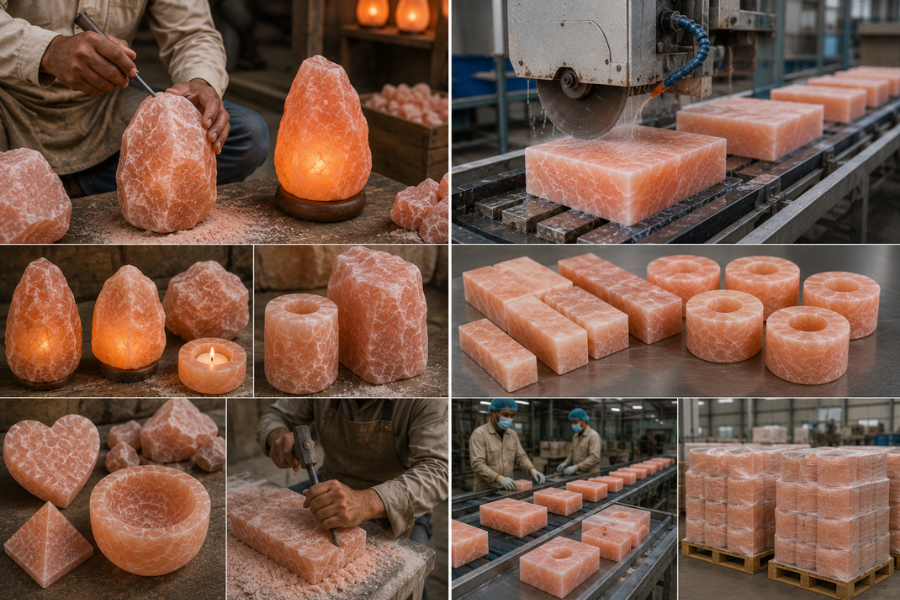
Handcrafted Himalayan salt products are created primarily through skilled manual work, where experienced craftsmen carefully shape, smooth, polish, and finish natural salt blocks using traditional techniques alongside basic production tools. Instead of relying entirely on automated machinery, artisans pay close attention to the natural structure of each salt crystal and adapt their work according to its unique shape, texture, and color variations. This process allows every finished product to retain its individual character, making handcrafted items especially attractive for customers seeking authentic natural décor. Products such as natural rock salt lamps, artistic candle holders, decorative sculptures, custom carvings, and premium gift items are often handcrafted because they benefit from careful manual finishing. Although machines may assist with basic cutting, much of the final shaping and products depend on the skill and experience of the craftsman. Since every piece of Himalayan salt is naturally different, handcrafted production embraces these variations rather than trying to eliminate them, resulting in products that are unique and visually distinctive while maintaining the authentic beauty of the original salt crystal.
What Are Machine-Finished Himalayan Salt Products?
Machine-finished Himalayan Salt products are manufactured using specialized industrial equipment designed to achieve accurate dimensions, consistent shapes, and efficient production for large commercial orders. Advanced cutting machines, polishing equipment, drilling systems, and precision finishing tools allow manufacturers to produce products that closely match customer specifications while maintaining high production efficiency. Machine finishing is especially valuable for products that depend on identical dimensions, such as salt tiles, bricks, cooking slabs, construction panels, and standardized edible salt packaging. Unlike handcrafted production, which highlights natural individuality, machine finishing focuses on uniformity and repeatability. Every product is processed according to predetermined measurements, making this method ideal for wholesale buyers, distributors, and construction projects where consistency is essential. Modern manufacturing equipment also reduces production time and improves the ability to fulfill large export orders within tight schedules. Although machine-finished products may appear more refined and symmetrical, they still preserve the natural color and mineral characteristics of authentic Himalayan salt because the raw material itself remains completely natural throughout the manufacturing process.
The Manufacturing Process Behind Handcrafted Salt Products
Creating handcrafted Himalayan salt products begins with selecting suitable natural salt blocks based on their size, crystal quality, color, and structural strength. Skilled craftsmen inspect every piece before determining how it should be shaped to maximize its natural appearance while minimizing unnecessary waste. Large blocks are first cut into manageable sections before artisans gradually carve, smooth, and refine each product using specialized hand tools and carefully controlled machinery. Throughout the manufacturing process, experienced workers continuously evaluate the natural grain, mineral patterns, and surface texture of the salt to avoid damaging the crystal structure. Small adjustments are often made during production because every salt block behaves differently depending on its density and internal composition. This flexibility allows craftsmen to preserve unique natural features that machines may overlook. The finishing stage includes smoothing rough surfaces, creating balanced proportions, and inspecting every item for quality before packaging. The combination of technical skill, artistic judgment, and attention to detail makes handcrafted Himalayan salt products highly valued among customers who appreciate individuality and traditional craftsmanship.
The Manufacturing Process Behind Machine-Finished Salt Products
Machine-finished Himalayan salt products follow a highly organized production process designed to maximize efficiency, precision, and consistency. After raw Himalayan salt blocks are selected and graded according to quality, they are transferred to specialized production equipment capable of cutting, grinding, drilling, polishing, and shaping products with remarkable accuracy. Computer-guided measuring systems and precision cutting machines help manufacturers achieve uniform sizes that meet customer specifications across thousands of identical products. This production method is especially important for large commercial orders where consistency directly influences customer satisfaction and installation quality. Machine finishing also allows manufacturers to reduce production time while improving material utilization by minimizing unnecessary cutting errors. Each product passes through multiple production stages before reaching quality inspection, where dimensions, surface finish, and structural integrity are carefully verified. Although automation performs much of the manufacturing work, experienced technicians still monitor equipment, inspect finished products, and make adjustments whenever necessary. The combination of modern machinery and skilled supervision allows manufacturers to efficiently produce premium Himalayan salt products for international wholesale markets.
Precision and Consistency
Precision is one of the strongest advantages of machine-finished Himalayan salt products. Modern manufacturing equipment is capable of producing thousands of identical pieces with highly accurate dimensions, making this production method ideal for projects that require consistency. Products such as Himalayan salt tiles, bricks, cooking slabs, wall panels, and architectural components often need precise measurements to ensure proper installation and professional results. Machine finishing allows manufacturers to maintain the same thickness, width, length, and surface quality across large production runs, reducing variation between individual pieces. Handcrafted products, while carefully made, naturally include small differences because every salt crystal responds differently during manual shaping. These slight variations are not considered defects but rather part of the charm of handmade products. For wholesale buyers, hotels, construction companies, and retailers ordering large quantities, consistency often becomes an important purchasing factor. Machine finishing helps manufacturers meet strict product specifications while maintaining production efficiency. Choosing between handcrafted and machine-finished products depends largely on whether uniqueness or dimensional consistency is the primary requirement for the intended application.
Customization Possibilities
Both handcrafted and machine-finished Himalayan salt products offer customization opportunities, but the methods used to achieve customized designs differ considerably. Handcrafted production provides exceptional flexibility because skilled artisans can adapt each product according to customer preferences, creating unique sculptures, engraved items, decorative carvings, custom-shaped salt lamps, or personalized gift products. Since craftsmen work directly with the natural salt, they can modify designs during production while preserving attractive crystal features. Machine-finished products also support customization, particularly for standardized dimensions, engraved logos, private-label production, and large commercial orders requiring identical specifications. Manufacturers often use precision equipment to produce customized salt bricks, cooking slabs, decorative panels, and branded retail products in consistent quantities. Businesses looking for exclusive premium collections often prefer handcrafted production because each item becomes naturally distinctive. On the other hand, companies supplying supermarkets, hotels, restaurants, and international distributors frequently select machine-finished products because customization can be combined with large-scale production efficiency. Both methods allow manufacturers to meet different customer needs while expanding product possibilities across global markets.
Comparing Production Speed and Manufacturing Efficiency
Production speed is another important factor that distinguishes handcrafted and machine-finished Himalayan salt products. Creating handmade products requires careful attention from experienced craftsmen, making the manufacturing process slower but highly detailed. Every piece is individually inspected, shaped, and refined, which naturally increases production time. This approach works well for premium decorative items, luxury gift collections, and custom-designed products where craftsmanship is more important than manufacturing speed. Machine-finished production, however, is designed for efficiency. Automated cutting, polishing, drilling, and shaping equipment allows manufacturers to process large quantities of Himalayan salt within shorter production cycles. This increased efficiency helps companies meet strict delivery schedules, especially when supplying wholesalers, distributors, retailers, and international buyers with bulk orders. Faster production also supports seasonal demand when customers require larger shipments within limited timeframes. Although handcrafted production cannot compete with machines in terms of output volume, it continues to offer exceptional value through craftsmanship and individuality. Manufacturers often combine both production methods to balance efficiency with artistic quality depending on customer requirements.
Cost Differences Between Handcrafted and Machine-Finished Products
Production methods also influence the final cost of Himalayan salt products. Handcrafted items generally require more labor, longer production times, and greater attention to detail, which naturally increases manufacturing costs. Skilled craftsmen spend considerable time shaping, refining, and inspecting every product, making handcrafted collections more suitable for premium markets where customers appreciate artistic value and uniqueness. Machine-finished products benefit from greater production efficiency because automated equipment reduces labor requirements while increasing output. As a result, manufacturers can produce standardized products at lower unit costs, particularly when handling large commercial orders. This makes machine-finished Himalayan salt products attractive for wholesalers, retailers, construction companies, and businesses purchasing in bulk. However, lower production costs do not necessarily mean lower quality. Both handcrafted and machine-finished products can meet high manufacturing standards when produced by experienced suppliers. Buyers should evaluate cost alongside intended application, customer expectations, product appearance, and branding strategy. Selecting the right production method helps businesses balance quality, pricing, and profitability while meeting the needs of their target markets.
Durability and Product Performance
Many buyers wonder whether handcrafted or machine-finished Himalayan salt products are more durable, but the answer depends more on the quality of the raw Himalayan salt than on the finishing method itself. Both handcrafted and machine-finished products are manufactured from the same natural Himalayan salt deposits, meaning their fundamental material properties remain unchanged. Durability is influenced by factors such as crystal density, careful processing, proper storage, packaging quality, and handling during transportation rather than whether the finishing was performed manually or by machine. Handcrafted products receive individual attention during production, allowing craftsmen to avoid weak areas within the salt crystal. Machine-finished products benefit from precise cutting and accurate shaping, which can improve structural consistency in products requiring exact dimensions. Regardless of the manufacturing method, Himalayan salt remains a natural mineral that should be handled carefully to prevent accidental damage. When properly manufactured, packaged, and maintained, both handcrafted and machine-finished products offer excellent durability and long service life for decorative, culinary, architectural, and wellness applications.
Which Products Are Best Made by Hand?
Certain Himalayan salt products are particularly well suited to handcrafted manufacturing because they benefit from artistic creativity and natural individuality. Natural rock-shape salt lamps are among the best examples, as customers often appreciate their irregular forms and unique crystal patterns. Decorative candle holders, carved sculptures, gift items, engraved products, and custom-designed pieces also gain additional value through manual craftsmanship. Luxury interior décor brands frequently choose handcrafted Himalayan salt products because they provide exclusivity that cannot easily be replicated through automated production. Hotels, spas, wellness centers, and boutique retailers often prefer handmade collections because every item becomes a conversation piece with its own natural appearance. Handcrafted production also works well for limited-edition collections and personalized corporate gifts where uniqueness enhances customer appeal. Although production volumes are smaller, these products often command higher market value because buyers recognize the craftsmanship involved. Handcrafted Himalayan Salt continues to represent the traditional side of the industry, preserving artisanal skills that have contributed to the popularity of these natural products around the world.
Which Products Benefit Most from Machine Finishing?
Machine finishing is the preferred manufacturing method for Himalayan salt products that require precise measurements, smooth surfaces, and consistent quality across large production quantities. Salt tiles, construction bricks, wall panels, cooking slabs, edible salt products, bath salts, and industrial salt materials all benefit from machine-controlled manufacturing because customers expect uniform specifications. Architectural projects, restaurants, hotels, and commercial distributors often require hundreds or thousands of identical pieces that fit together accurately during installation or packaging. Machine finishing allows manufacturers to meet these expectations while reducing production time and maintaining consistent quality. Retail businesses also benefit because standardized products simplify inventory management and improve product presentation on store shelves. Export customers frequently specify exact product dimensions and packaging requirements that can be achieved efficiently through automated production systems. While machine-finished products may appear more refined and symmetrical than handcrafted items, they still retain the natural color, mineral composition, and authenticity of genuine Himalayan salt. This combination of precision and natural beauty makes machine finishing highly valuable for modern commercial manufacturing.
How Buyers Can Choose the Right Option
Choosing between handcrafted and machine-finished Himalayan Salt products depend entirely on the buyer’s objectives, target market, and intended application. Businesses focused on luxury home décor, boutique retail, personalized gifts, or artistic collections often achieve better results with handcrafted products because customers appreciate originality and traditional craftsmanship. On the other hand, wholesalers, distributors, construction companies, hospitality businesses, and food manufacturers generally prioritize consistency, production capacity, and competitive pricing, making machine-finished products the more practical choice. Buyers should also consider customization requirements, delivery schedules, packaging preferences, and long-term business goals before selecting a manufacturing method. Working with an experienced Himalayan salt manufacturer allows businesses to explore both options and choose the solution that best matches their product strategy. Many suppliers even combine handcrafted finishing with machine-assisted production to deliver products that offer both precision and artistic appeal. Understanding these differences helps buyers make informed purchasing decisions while ensuring they receive products that meet customer expectations and support long-term business success.
Conclusion
Handcrafted and machine-finished Himalayan salt products each play an important role in today’s global Himalayan salt industry. While handcrafted products emphasize individuality, traditional craftsmanship, and the natural character of every salt crystal, machine-finished products provide outstanding precision, consistency, and production efficiency for large commercial orders. Neither manufacturing method is universally better than the other because each serves different customer needs and market demands. Decorative collections, premium gifts, and artistic products often benefit from handcrafted production, while construction materials, cooking slabs, retail packaging, and wholesale products are better suited to machine finishing. Successful manufacturers understand the strengths of both approaches and apply them according to the product being produced. Buyers who understand these differences can confidently choose products that match their quality expectations, budget, and intended use. As global demand for Himalayan salt products continues to grow, both handcrafted expertise and modern manufacturing technology will remain essential in delivering authentic, high-quality products to customers around the world.