Certifications play a vital role in the global Himalayan salt trade, especially for buyers sourcing edible salt, animal lick salt, bath salt, and decorative salt products from Pakistan. As international markets become more regulated and quality-conscious, certifications act as proof of safety, compliance, authenticity, and ethical sourcing. For buyers, certifications reduce risk and ensure regulatory acceptance, while for exporters, they open doors to premium markets and long-term partnerships. This article explains the most commonly used certifications in the Himalayan salt trade, why they matter, how they are obtained, and how they impact international business decisions. Understanding these certifications helps buyers and sellers communicate clearly, meet market expectations, and build trust across borders.
Why Certifications Matter in the Himalayan Salt Industry
Certifications serve as a bridge of trust between Himalayan salt exporters and international buyers. Since salt is consumed by humans and animals and used in wellness applications, buyers need assurance that the product meets specific safety, hygiene, and quality standards. Certifications confirm that the salt has been processed under controlled conditions and complies with international regulations. They also help buyers clear customs smoothly and meet retailer or distributor requirements. In competitive global markets, certified Himalayan salt stands out as a reliable product. Without proper certifications, even high-quality salt may face rejection, delays, or limited market access, making certifications an essential part of international trade.
Food Grade Certification for Edible Himalayan Salt
Food-grade certification is one of the most important requirements for edible Himalayan pink salt. This certification confirms that the salt is safe for human consumption and processed according to strict food safety and hygiene standards. Food-grade salt undergoes washing, drying, grading, and quality testing to ensure acceptable purity levels, controlled moisture content, and absence of contaminants. Buyers in food manufacturing, restaurants, and retail chains rely on this certification to comply with local and international food laws. Food-grade certification also reassures consumers that the salt has been handled hygienically and meets high safety expectations. In international trade, food-grade status is often supported by detailed laboratory test reports and documentation, making it a foundational requirement for edible salt exports.
ISO Certification in Himalayan Salt Processing Facilities
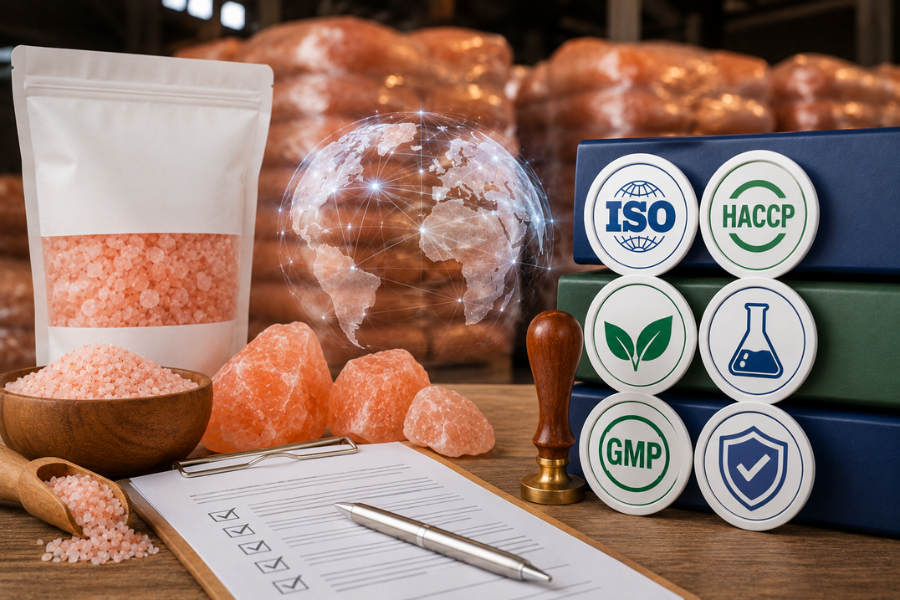
ISO certification demonstrates that a Himalayan salt supplier follows internationally recognized management and quality systems. Common ISO standards include ISO 9001 for quality management and ISO 22000 for food safety management. These certifications indicate that the exporter has documented processes, consistent production methods, and continuous improvement systems across all operational areas. For buyers, ISO certification reduces operational risk, ensures predictable product quality, and confirms adherence to global best practices. In B2B trade, ISO-certified suppliers are often preferred for long-term contracts and bulk supply agreements. Although ISO certification does not certify the product itself, it validates the systems behind production, making it highly valuable in international salt trade and procurement decisions.
Halal Certification for Himalayan Salt Products
Halal certification is essential for markets with Muslim consumers and regions where halal compliance is mandatory. Himalayan salt is naturally halal, but certification confirms that all processing, packaging, storage, and handling meet strict Islamic dietary laws. Halal certification ensures that no prohibited substances, additives, or cross-contamination occur during production. Buyers in the Middle East, Southeast Asia, and Muslim-majority countries often require halal certificates for edible salt, animal feed products, and wellness-related salts. This certification enhances market access, regulatory compliance, and consumer trust. For exporters, halal certification expands business opportunities, strengthens brand credibility, and supports long-term growth in halal-sensitive international markets.
FDA Registration and Compliance for Salt Exports
FDA registration is commonly required for exporters supplying edible Himalayan salt to the United States. This registration confirms that the processing facility fully complies with U.S. food safety regulations and industry best practices. While FDA registration does not mean FDA approval, it legally allows exporters to ship food products into the U.S. market. Buyers rely on FDA compliance to avoid customs issues, import delays, and regulatory penalties. Exporters must maintain accurate records, follow hygiene protocols, and adhere to labeling rules. FDA registration signals professionalism, regulatory readiness, and credibility, making it a valuable asset for Himalayan salt exporters targeting North American food markets.
Certificate of Origin in Himalayan Salt Trade
The Certificate of Origin confirms that Himalayan salt originates from Pakistan, specifically from the Himalayan region. This document is crucial for customs clearance, tariff assessment, and trade agreements, ensuring smooth import processes. Buyers often require this certificate to qualify for preferential duty rates, comply with import regulations, or satisfy retailer or distributor documentation requirements. The Certificate of Origin also supports authenticity claims, particularly for Himalayan pink salt, which is geographically unique and highly valued. For buyers concerned about counterfeit or mislabeled salt, this certification provides reliable assurance of genuine origin. It is a standard requirement in almost all international Himalayan salt shipments, strengthening trust between exporters and buyers.
Laboratory Test Reports and Quality Analysis Certificates
Laboratory test reports are widely used in the Himalayan salt trade to verify chemical composition, purity, and mineral content. These reports confirm NaCl percentage, moisture levels, and the absence of harmful contaminants, heavy metals, or adulterants. For edible salt, food safety parameters are tested, while animal lick salt may be tested for accurate mineral balance and suitability for livestock consumption. Buyers use lab reports to validate product claims, comply with international regulatory requirements, and support import approvals. Test reports are usually issued by accredited laboratories and accompany export documentation. Although not always legally mandatory, lab analysis certificates greatly enhance buyer confidence, transparency, and credibility in international Himalayan salt transactions.
Animal Feed Grade Certification for Salt Licks
Animal lick salt requires specific certifications to confirm suitability for livestock consumption. Feed-grade certification ensures that the salt meets strict safety standards for animals and contains appropriate essential mineral levels. Buyers in agriculture and livestock industries depend on this certification to protect animal health, maintain productivity, and prevent toxicity or deficiency issues. Feed-grade certification may involve testing for impurities and microbial contamination and verifying hardness, durability, and consistent mineral release. In international trade, certified animal lick salt faces fewer regulatory barriers and facilitates smoother import approvals. This certification also demonstrates that the exporter understands agricultural industry requirements and reliably supplies responsibly processed, high-quality products for livestock nutrition.
GMP Certification in Himalayan Salt Manufacturing
Good Manufacturing Practices, or GMP certification, confirms that Himalayan salt is produced under hygienic, controlled, and standardized conditions. GMP focuses on cleanliness, worker hygiene, equipment maintenance, contamination prevention, and traceable production procedures. This certification is especially important for edible and bath salt products, where safety and purity directly affect consumer trust. Buyers view GMP certification as a sign of professionalism, operational discipline, and effective risk management. While not always mandatory, GMP certification strengthens compliance with food and cosmetic standards, supports regulatory inspections, and enhances international buyer confidence. For exporters, GMP certification complements ISO, food-grade, and halal certifications, creating a robust, market-ready quality assurance profile.
Organic and Natural Claims in the Himalayan Salt Trade
Many buyers associate Himalayan salt with natural and organic qualities. While salt itself cannot be certified organic in the traditional sense, some suppliers provide natural processing declarations or clean-label confirmations. These statements verify that no additives, chemicals, refining agents, or artificial colorants are used. Buyers use these declarations for marketing, brand positioning, and consumer transparency. However, exporters must be careful to avoid misleading claims or exaggerations, as regulatory authorities may enforce compliance. Supporting documentation, transparent labeling, and honest communication are essential. Natural processing certifications or formal declarations help align Himalayan salt products with clean-label trends, wellness markets, and international consumer expectations.
REACH and Compliance for European Markets
For exporters supplying Himalayan salt to Europe, REACH compliance may be required, particularly for industrial, cosmetic, or non-food applications. REACH ensures that substances entering the EU meet strict chemical safety and environmental regulations. Although naturally occurring salt is generally exempt from full registration, buyers often request REACH statements or safety declarations as part of due diligence and risk management. Providing these compliance documents helps avoid customs delays, regulatory inspections, or shipment rejections, while demonstrating exporter reliability and professionalism. Understanding European regulatory requirements enables exporters to confidently serve EU markets, maintain uninterrupted supply chains, and build trust with industrial, cosmetic, and retail buyers alike.
Packaging and Labeling Certifications
Proper packaging and labeling certifications ensure that Himalayan salt meets destination market requirements and international trade standards. These certifications confirm that packaging materials are food-grade, moisture-resistant, tamper-proof, and suitable for edible, animal, or bath salt use. Labeling certifications verify that product information, including ingredient lists; origin; net weight; batch numbers; handling instructions; and usage guidelines, complies with local and international regulations. Accurate and compliant labeling helps buyers avoid legal issues, import rejections, and consumer complaints. For retail, private-label, and branded products, proper packaging and labeling demonstrate professionalism, enhance brand credibility, and support market differentiation. Exporters who prioritize these certifications gain a competitive edge, improve buyer trust, and facilitate smooth global distribution.
Certifications for Private Label Himalayan Salt Products
Private label Himalayan salt requires additional certifications to protect buyer brands and ensure regulatory compliance. Buyers often request facility certifications, ISO, GMP, food-grade, halal, and lab test reports before approving private-label production. These certifications guarantee that the supplier can consistently maintain quality, purity, and traceability under the buyer’s brand name. Exporters working with private label clients must carefully manage documentation, packaging, and labeling to align with contractual and regulatory requirements. Certifications also verify authenticity, ingredient safety, and processing standards, which are critical for consumer trust. Proper certification management helps secure private label contracts, build long-term partnerships, enhance brand reputation, and facilitate smooth international market entry.
How Certifications Impact Buyer Trust and Pricing
Certifications directly influence buyer trust and pricing negotiations in the Himalayan salt trade. Certified products often command higher prices due to reduced risk, verified authenticity, and broader market acceptance. Buyers are willing to pay a premium for documented quality, compliance with food, feed, or cosmetic standards, and reliable traceability. Certifications also reduce the likelihood of shipment rejections, regulatory penalties, and legal disputes. For exporters, investing in certifications enhances brand reputation, demonstrates professionalism, and opens access to stricter, high-value markets. Over time, certifications contribute to stronger buyer confidence, long-term partnerships, stable demand, and sustainable business growth across international Himalayan salt trade channels.
Managing Certification Requirements Efficiently
Efficient certification management requires careful planning, thorough documentation, and regular internal and external audits to ensure all standards are consistently met. Exporters should maintain updated certificates, laboratory reports, and compliance documents while proactively communicating with buyers about available certifications. Buyers should clearly specify their requirements early in negotiations to prevent misunderstandings or delays. Transparent handling of certifications not only ensures regulatory compliance but also builds trust, strengthens trade relationships, and demonstrates professionalism. Exporters who implement organized tracking systems, anticipate renewal timelines, and maintain accurate records position themselves as reliable, long-term suppliers capable of meeting diverse international market demands efficiently and consistently.
Conclusion
Certifications are the backbone of a successful Himalayan salt trade, ensuring safety, authenticity, and regulatory compliance. From food-grade and halal certificates to ISO systems, GMP standards, and laboratory reports, each certification plays a unique role in international business. Buyers rely on these documents to protect their markets, while exporters use them to expand globally, secure higher-value contracts, and maintain long-term buyer confidence. Understanding, obtaining, and managing certifications effectively transforms Himalayan salt from a natural resource into a trusted global commodity. In today’s strictly regulated trade environment, certifications are not optional but essential for sustainable, profitable, and reputable success in international markets.