
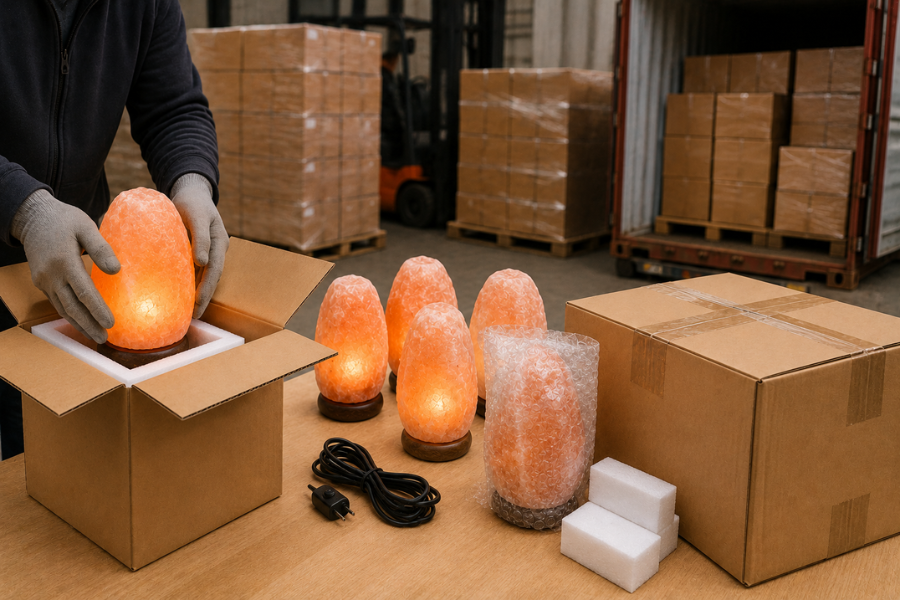
For manufacturers and wholesalers, exporting Himalayan salt lamps requires far more than simply placing a fragile product inside a box. Because salt lamps are heavy, moisture-sensitive, and naturally brittle, proper packing and exporting procedures are essential to protect the product and preserve its quality during long international journeys. From mining regions in Pakistan to global destinations across Europe, North America, and Asia, salt lamps travel through multiple handling points, climate conditions, and transportation modes. Each stage introduces potential risks that exporters must manage carefully. For importers alike, understanding the correct packing materials, export standards, moisture control methods, and shipping documentation is key to reducing damage, avoiding returns, and maintaining brand credibility. This guide explains how Himalayan salt lamps are packed for export, the logistics involved, and the best practices followed by experienced exporters to ensure safe delivery. Whether you are sourcing salt lamps for retail or exporting in bulk, knowing these processes helps you make informed and confident trade decisions.
Why Proper Packing Is Critical for Exporting Salt Lamps
Himalayan salt lamps are carved from solid salt crystal, making them both heavy and sensitive to environmental factors such as humidity, pressure, and impact. Improper packing can lead to cracks, surface erosion, or complete breakage before the shipment even reaches its destination. Because salt absorbs moisture from the air, exposure during transit can cause sweating, discoloration, or structural weakening, especially during sea freight or storage in humid ports. Export-grade packing minimizes these risks by stabilizing the lamp, controlling moisture levels, and absorbing shocks during handling. International shipping often involves container loading, unloading, stacking, and vibrations, all of which place stress on inadequately packed lamps. Professional exporters focus on multilayer protection rather than relying on a single packing material. This approach ensures that even if the outer packaging is compromised, the lamp inside remains intact. Proper packing not only protects the physical product but also reduces insurance claims, customer dissatisfaction, and financial losses associated with damaged shipments.
Primary Protective Materials Used in Salt Lamp Packing
The first layer of protection for a salt lamp usually involves wrapping the product in moisture-resistant materials that prevent direct contact with humid air. Plastic wrapping, shrink film, or laminated covers are commonly used to seal the lamp’s surface while still allowing flexibility. This layer acts as a barrier against moisture absorption, which is critical during long shipping routes or warehouse storage. After sealing, cushioning materials such as foam sheets, bubble wrap, or molded inserts are applied to absorb shocks and prevent movement inside the carton. The thickness of these materials depends on the lamp’s weight and shape. Heavier lamps require denser cushioning to distribute pressure evenly. Exporters carefully balance protection with cost efficiency, ensuring that the packing is strong without unnecessarily increasing shipment weight. The use of high-quality protective materials reflects professionalism and significantly improves the chances of the lamps arriving in perfect condition.
Outer Carton Selection and Structural Strength
The outer carton plays a crucial role in export packing, especially for bulk shipments. Salt lamps are typically packed in high-strength corrugated boxes designed to withstand stacking pressure and rough handling. Double-wall or triple-wall cartons are preferred for international exports because they provide enhanced durability and load resistance. Carton size is carefully matched to the lamp dimensions to prevent excess movement inside the box. Too much empty space increases the risk of impact damage, while overly tight packing can cause pressure cracks. Exporters also consider the carton’s resistance to moisture and tearing, particularly for sea shipments where condensation inside containers is common. Reinforced corners, sealed seams, and proper labeling further improve carton integrity. Strong outer packaging ensures that the lamp remains protected throughout its journey, even when subjected to unpredictable shipping conditions.
Moisture Control Techniques During Export
Moisture control is one of the most critical aspects of exporting Himalayan salt lamps. Because salt naturally attracts moisture, exporters must take extra steps to manage humidity inside cartons and containers. Desiccant packets, silica gel, or moisture absorbers are often placed inside individual boxes or master cartons to regulate internal humidity levels. In addition to internal moisture control, exporters ensure that cartons are stored in dry environments before shipment and loaded into clean, well-ventilated containers. Container liners or moisture barrier sheets may also be used to reduce condensation during sea freight. These precautions help prevent sweating, melting, or surface damage caused by prolonged exposure to damp conditions. Effective moisture management preserves the lamp’s appearance and ensures that buyers receive a clean, dry, and ready-to-use product upon delivery.
Bulk Packing Methods for Wholesale Shipments
For wholesale exports, salt lamps are often packed in bulk master cartons or pallets to optimize space and reduce shipping costs. Bulk packing requires careful planning to ensure that each lamp is individually protected while still allowing efficient handling. Exporters typically use partitioned cartons or internal dividers to separate lamps and prevent direct contact. Palletization is another common practice, especially for large orders. Cartons are stacked uniformly on pallets and secured with stretch wrap or strapping to prevent shifting during transit. Proper weight distribution across pallets is essential to avoid crushing lower cartons. Bulk packing not only improves logistical efficiency but also reduces labor costs during loading and unloading. When executed correctly, it ensures that large quantities of salt lamps can be shipped safely and economically to international buyers.
Export Documentation and Compliance Requirements
Exporting salt lamps involves compliance with international trade regulations and proper documentation. Exporters must prepare commercial invoices, packing lists, certificates of origin, and shipping bills to facilitate customs clearance. Accurate documentation ensures transparency and prevents delays at ports of entry. Depending on the destination country, additional requirements such as fumigation certificates for wooden pallets or specific labeling standards may apply. Exporters must also comply with import regulations related to product safety, electrical components, and packaging materials. Clear communication between exporters, freight forwarders, and importers helps ensure that all paperwork is complete and accurate. Proper documentation not only speeds up customs clearance but also builds trust with international partners and regulatory authorities.
Transportation Modes Used for Exporting Salt Lamps
Salt lamps are exported using various transportation modes depending on order size, destination, and delivery timelines. Sea freight is the most common option for bulk shipments due to its cost efficiency, although it requires careful moisture control. Air freight is sometimes used for smaller or urgent orders, offering faster delivery but higher costs. Road and rail transport are often used for inland movement from manufacturing sites to ports. Each transportation mode presents unique challenges, such as vibration, temperature changes, or handling frequency. Exporters select shipping methods based on balancing cost, speed, and product safety. Understanding the strengths and limitations of each mode allows exporters to choose the most suitable option for their specific shipment requirements.
Quality Inspection Before Packing and Export
Before packing, salt lamps undergo quality inspection to ensure they meet export standards. Inspectors check for cracks, uneven surfaces, electrical functionality, and overall appearance. Lamps that do not meet quality criteria are removed from the export batch to prevent customer complaints and returns. Quality inspection also includes verifying weight consistency, base stability, and cord safety. By identifying issues early, exporters avoid shipping defective products that could damage their reputation. Thorough inspection reinforces buyer confidence and supports long-term business relationships. Quality control before packing ensures that only premium-grade salt lamps are exported to international markets. This step also ensures electrical safety, structural stability, visual consistency, and compliance with international import regulations before final shipment approval.
Branding, Labeling, and Buyer Customization
Export packing often includes branding and labeling based on buyer requirements. Custom labels may display brand names, logos, usage instructions, and country-of-origin information. Proper labeling enhances product presentation and helps buyers meet retail compliance standards. Some buyers request customized packing designs, gift boxes, or private labeling for their markets. Exporters accommodate these requests while maintaining protective integrity. Clear communication during order confirmation ensures that branding expectations align with export capabilities. Well-executed labeling adds value to the product and strengthens brand recognition in competitive international markets. This flexibility in branding also allows exporters to support regional language requirements, retail shelf standards, and evolving packaging trends in global markets.
Final Thoughts on Packing & Exporting Salt Lamps
Packing and exporting Himalayan salt lamps is a specialized process that combines material science, logistics expertise, and international trade knowledge. From moisture control and protective materials to documentation and transportation planning, every step plays a role in delivering high-quality products to global buyers. Exporters who invest in proper packing practices reduce risks, enhance customer satisfaction, and build long-term credibility in international markets. For importers and wholesalers, understanding these processes helps evaluate supplier professionalism and product reliability. When packing and exporting are done correctly, Himalayan salt lamps reach customers safely, preserving their natural beauty and commercial value. Consistent packing quality ultimately protects long-term trade relationships, minimizes transit risks, and strengthens buyer confidence in repeated international orders.