
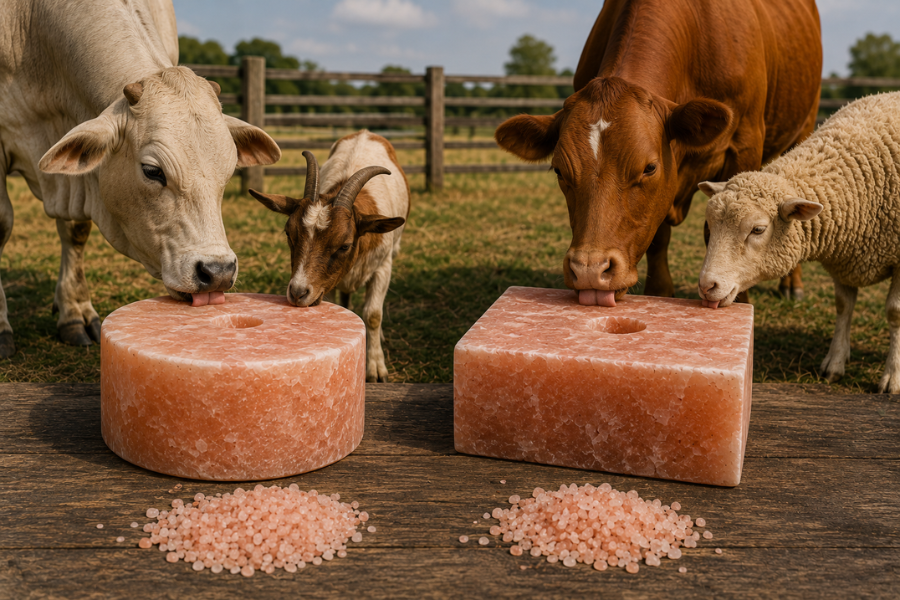
Animal salt licks have become an important part of modern livestock management because farmers understand the importance of providing essential minerals to cattle, goats, sheep, and other animals. Among the different types available in the market, Himalayan Salt Licks are especially popular because they are made from natural mineral-rich salt and are widely used by farms around the world. However, when purchasing animal salt licks, many farmers and businesses often ask an important question: should they choose round salt licks or square salt licks? Both shapes provide essential salt supplementation, but their designs offer different advantages depending on animal type, usage conditions, and farming requirements. Round and square Himalayan Salt Licks are available in different weights and sizes, making them suitable for small farms as well as large livestock operations. Understanding the differences between these two shapes can help farmers, distributors, and buyers make better purchasing decisions. This guide explains the key differences between round and square animal salt licks, including durability, handling, animal accessibility, storage, and suitability for different livestock environments.
Understanding Himalayan Animal Salt Licks
Himalayan Animal Salt Licks are natural salt products designed to provide livestock with important minerals needed for their daily nutritional requirements. These salt blocks are commonly used for cattle, horses, goats, sheep, and other farm animals because they offer a convenient way for animals to access salt whenever needed. Unlike ordinary table salt, Himalayan Salt Licks are produced from natural salt deposits and maintain their natural mineral composition. Farmers often place these blocks in fields, barns, grazing areas, and feeding spaces where animals can lick them freely. The shape of the salt lick plays a role in how easily animals interact with the product and how long it lasts in different conditions. Round and square salt licks are two of the most common designs available in the livestock market. While the purpose of both shapes is the same, their physical structure affects handling, placement, durability, and suitability for different farming environments. Choosing the right shape depends on factors such as animal size, farm conditions, and the preferences of the livestock owner.
Round Animal Salt Licks: Features and Advantages
Round Animal Salt Licks are one of the most traditional and widely used designs in livestock farming. Their smooth circular shape provides several practical advantages, especially when used with larger animals such as cattle and horses. Because there are no sharp corners, round salt licks are easy for animals to approach and use from different angles. This allows multiple animals to access the block comfortably, especially when placed in open grazing areas. The rounded shape also helps reduce uneven wearing because animals naturally lick around the surface rather than focusing on specific corners. Many farmers prefer round salt licks because they are simple to handle, easy to place, and suitable for outdoor environments. Their compact design makes them convenient for transportation and storage, especially when buying in bulk. Round Himalayan Salt Licks are also popular among exporters and distributors because their shape is recognized internationally and accepted by many livestock markets. For farms with free-ranging animals, round salt blocks can provide a practical solution that combines durability, accessibility, and efficient mineral supplementation.
Square Animal Salt Licks: Features and Advantages
Square Animal Salt Licks are another popular option used by farmers, ranchers, and livestock businesses worldwide. Their structured shape provides stability and makes them easier to stack, transport, and store compared with some rounded designs. Many commercial farms prefer square salt licks because their flat surfaces allow organized placement in storage areas and during transportation. The straight edges also make them suitable for certain feeding setups where blocks need to fit into holders, containers, or designated spaces. Square Himalayan Salt Licks are commonly used for cattle, goats, sheep, and other livestock because they provide a strong and durable mineral source. Their larger flat surfaces can also allow animals to access the salt comfortably from different positions. For suppliers and wholesalers, square designs can be easier to package efficiently because they maximize available space during shipping. This can reduce packaging challenges and improve handling during export operations. While the shape does not change the mineral value of the salt, the practical advantages of square blocks make them a preferred option for many professional livestock operations.
Comparing Durability: Round vs Square Salt Licks
When comparing durability between round and square animal salt licks, several factors should be considered, including weather conditions, animal behavior, and placement environment. Both shapes can provide long-lasting performance when made from high-quality Himalayan salt and used correctly. Round salt licks often experience more balanced wearing because animals can access the entire surface naturally, which may help the block maintain its shape over time. Their smooth design can also reduce areas where cracks may begin under certain conditions. Square salt licks, however, offer strong structural stability because their flat sides and solid edges make them easier to handle during transportation and installation. For farms that require organized storage or frequent movement of salt blocks, square designs may provide practical advantages. Ultimately, durability depends more on salt quality, production standards, and environmental exposure than the shape alone. A premium Himalayan salt lick from a reliable supplier can perform well in either round or square form. Farmers should consider their specific conditions rather than choosing only based on appearance when selecting livestock salt blocks.
Which Shape Is Better for Cattle: Round or Square Animal Salt Licks?
When choosing between round and square animal salt licks for cattle, farmers should consider factors such as herd size, feeding environment, and how the animals access the mineral block. Cattle are naturally curious animals that regularly use salt licks to support their mineral intake, and both shapes can work effectively when placed correctly. Round salt licks are often preferred for open grazing areas because their smooth shape allows cattle to approach the block from different directions. This can be useful when multiple animals gather around the same salt source. Square salt licks, however, are often selected for managed farms because their stable shape makes them easier to place in specific feeding areas or holders. Large cattle operations may choose square blocks because they are easier to transport, stack, and organize in storage facilities. The best option depends on the farm setup rather than the shape alone. High-quality Himalayan Salt Licks in either design can provide valuable mineral supplementation. Farmers should focus on product quality, correct placement, and regular availability when choosing salt blocks for cattle.
Round vs Square Salt Licks for Goats and Sheep
Goats and sheep have different feeding behaviors compared with larger livestock, and the choice between round and square salt licks can depend on how the animals interact with the block. Smaller animals often prefer salt blocks that are easy to reach and comfortable to use. Round salt licks can be beneficial because their curved surface allows animals to lick from different angles without difficulty. This can be especially useful in mixed herds where multiple goats or sheep use the same block. Square salt licks also work well because their stable shape makes them easy to place in feeding areas where smaller animals can access them safely. Many farmers choose square blocks for enclosed farms because they can be positioned neatly in designated locations. For goat and sheep owners, size and weight may be more important considerations than shape. Smaller Himalayan Salt Licks are often easier for these animals to use and easier for farmers to manage. Whether round or square, the most important factor is ensuring that animals have consistent access to a clean and reliable mineral source.
Outdoor Farming: Which Salt Lick Shape Performs Better?
Outdoor farming conditions can influence how well a salt lick performs, especially when blocks are exposed to changing weather conditions. Farms with open pastures, grazing fields, and large animal areas often require salt licks that can handle regular outdoor use. Round Himalayan Salt Licks are commonly chosen for outdoor environments because their smooth structure allows animals to use the surface evenly. Their shape can also reduce areas where moisture may collect compared with designs that have sharp corners. Square salt licks can also perform well outdoors, especially when placed on stable surfaces or inside protective holders. Their flat base provides good stability, which can be useful in areas with strong animal movement. Weather protection is important for both designs because excessive rain and humidity can affect natural salt products. Many professional farmers place salt licks under shelters or covered areas to extend their lifespan. The overall performance of a salt block depends more on placement, salt quality, and environmental protection than whether the design is round or square.
Indoor Farming and Barn Use: Choosing the Right Salt Lick Shape
For indoor farming environments such as barns, livestock shelters, and controlled feeding areas, the choice between round and square salt licks often depends on convenience and farm management practices. Square salt licks are frequently preferred in indoor settings because their flat surfaces make them easier to organize and position in specific locations. Farmers can place them near feeding areas, mineral stations, or designated livestock spaces without worrying about unnecessary movement. Round salt licks are also suitable for barns because animals can easily access them from multiple sides. The choice may depend on the available space and how many animals share the same area. In smaller barns, a compact square block may provide easier placement, while larger facilities may benefit from multiple round blocks positioned throughout the space. Professional livestock operations often evaluate handling, storage, and animal accessibility before choosing a specific design. Both shapes can provide excellent results when made from authentic Himalayan salt and managed properly. The right choice is the one that fits the farm’s daily routine and animal management system.
Wholesale Buying Guide for Round and Square Animal Salt Licks
Businesses purchasing Himalayan Animal Salt Licks in bulk need to consider several factors beyond shape, including quality, packaging, supplier reliability, and customer demand. Wholesale buyers such as livestock suppliers, agricultural distributors, and export companies often stock both round and square designs because different markets have different preferences. Round salt licks may appeal to farmers who prioritize traditional designs and easy animal access, while square blocks may attract buyers who prefer convenient storage and transportation. Packaging is also an important consideration for wholesale orders because properly packed salt licks are easier to handle during shipping. Reliable suppliers should provide consistent product quality, accurate sizing, and suitable packaging options for different markets. Businesses exporting Himalayan Salt Licks should also consider international customer preferences because some regions may have stronger demand for specific shapes. Offering multiple designs allows companies to serve a wider range of customers. A professional supplier can help businesses select the right combination of products according to market requirements, livestock types, and distribution goals.
Export Considerations for Round and Square Himalayan Salt Licks
The global demand for Himalayan Salt Licks has increased as livestock industries continue searching for natural mineral supplementation products. Exporters often compare round and square designs based on packaging efficiency, shipping costs, and customer preferences in different countries. Square salt licks may provide advantages during transportation because their structured shape allows more efficient stacking and packaging. This can help maximize container space and simplify logistics. Round salt licks, however, remain popular in many markets because farmers recognize their traditional design and practical usability. Exporters should understand that both shapes have strong market potential depending on the target region. Proper documentation, quality control, protective packaging, and reliable production standards are essential for successful international trade. Working with experienced Himalayan salt manufacturers helps exporters maintain consistent supply and meet buyer expectations. Since livestock businesses around the world have different requirements, offering both round and square options can create better opportunities. The key to successful export is not choosing only one shape but providing high-quality products that match the needs of different agricultural markets.
Price Comparison Between Round and Square Animal Salt Licks
The price difference between round and square animal salt licks depends on several factors, including size, weight, production method, packaging, and supplier pricing. In many cases, the shape itself does not create a major difference in cost because both products are made from the same natural Himalayan salt material. However, manufacturing processes and packaging requirements may influence the final price. Square salt licks may sometimes offer logistical advantages because their shape allows easier stacking and transportation. Round salt licks may require different handling methods because of their curved design. For farmers purchasing small quantities, the price difference may be less important than choosing a product that fits their animals and farm environment. For wholesalers and exporters ordering large volumes, packaging efficiency and shipping costs become more important factors. Businesses should compare suppliers based on overall value, including product quality, reliability, and service. A slightly higher-quality salt lick can provide better performance and customer satisfaction compared with cheaper alternatives.
Final Decision: Round or Square Animal Salt Lick?
Choosing between round and square animal salt licks ultimately depends on the specific needs of farmers, livestock owners, and businesses. Both designs provide the same fundamental purpose: supplying animals with a natural source of salt and minerals. Round salt licks are often preferred for open grazing environments because their smooth shape allows easy access from different directions and supports natural animal behavior. Square salt licks are commonly selected for organized farming systems because they are stable, easy to store, and convenient to handle. Neither shape is universally better because different farms have different requirements. Factors such as animal type, farm layout, weather conditions, storage facilities, and purchasing goals should all be considered before making a decision. For businesses, offering both round and square Himalayan Salt Licks can help meet the needs of a wider customer base. By choosing authentic, high-quality products from reliable suppliers, farmers can ensure better mineral supplementation and long-term value from their investment.
Conclusion
Round and square Himalayan Animal Salt Licks both provide effective mineral supplementation for cattle, goats, sheep, and other livestock. The choice between them depends mainly on practical needs rather than nutritional differences. Round salt licks offer natural accessibility and are popular for open grazing environments, while square salt licks provide stability, easy storage, and convenient handling. Farmers and businesses should evaluate their specific requirements before selecting a shape. Quality, authenticity, and supplier reliability remain the most important factors when purchasing Himalayan Salt Licks. As demand for natural livestock products continues growing worldwide, both round and square salt licks will continue playing an important role in modern animal care. Whether used on small farms or large agricultural operations, a well-made Himalayan Salt Lick can provide lasting value and support better livestock management practices.