
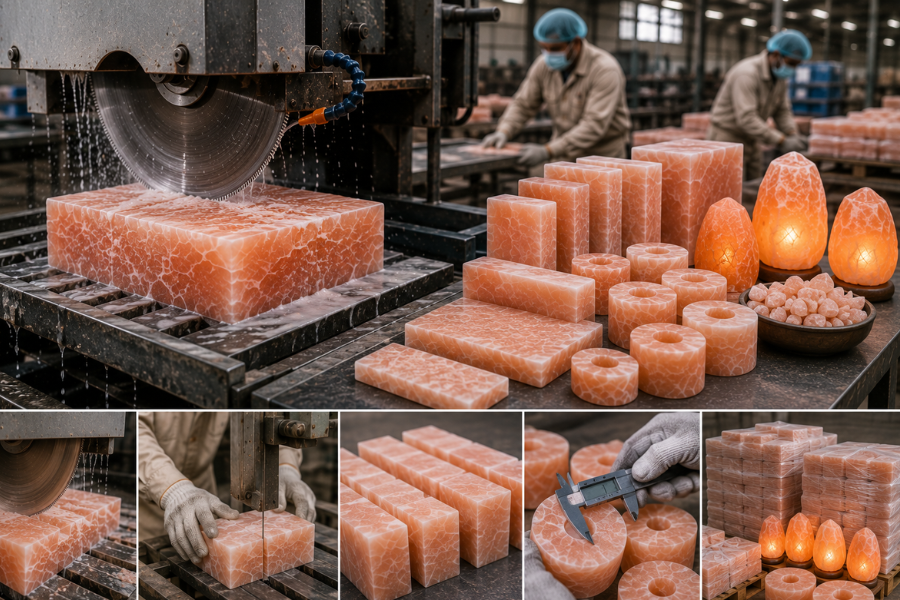
Himalayan salt products are valued worldwide for their natural beauty, versatility, and wide range of applications in food, wellness, interior design, and decorative markets. From elegant salt lamps and cooking slabs to architectural tiles, bricks, candle holders, and bath salts, every finished product begins as a solid block of natural Himalayan salt extracted from underground mines in Pakistan. While the raw material is naturally beautiful, transforming it into premium products requires exceptional care and accuracy. One of the most important stages in manufacturing is precision cutting, a process that determines the size, shape, strength, and overall quality of the finished product. Accurate cutting allows manufacturers to create products that meet customer specifications while minimizing waste and preserving the natural characteristics of the salt crystal. Whether producing handcrafted decorative pieces or machine-finished commercial products, precision cutting influences every stage of production. Understanding why this process matters helps buyers appreciate the craftsmanship, technology, and quality standards behind authentic Himalayan salt products supplied to markets around the world.
What Is Precision Cutting in Himalayan Salt Manufacturing?
Precision cutting refers to the careful process of shaping Himalayan salt blocks into specific sizes and forms using specialized equipment and skilled manufacturing techniques. Unlike ordinary stone processing, Himalayan salt requires controlled cutting because it is a natural mineral with unique crystal structures that must be preserved during production. Manufacturers use advanced saws, cutting machines, and measuring systems to create products with smooth edges, accurate dimensions, and minimal structural damage. Every cut must be carefully planned because unnecessary mistakes can produce cracks, uneven surfaces, or material waste. Precision cutting is used for a wide variety of products, including salt lamps, cooking slabs, decorative tiles, architectural bricks, candle holders, salt panels, and customized commercial products. Skilled operators continuously monitor the cutting process to ensure that each piece meets customer specifications before moving to polishing, shaping, or finishing stages. This combination of modern equipment and experienced craftsmanship allows manufacturers to produce consistent, high-quality Himalayan salt products suitable for domestic and international markets.
Why Accurate Measurements Are Essential
Accurate measurements form the foundation of successful Himalayan salt manufacturing because every finished product must match customer expectations and intended applications. Restaurants ordering cooking slabs require consistent dimensions to ensure even food presentation, while architects installing Himalayan Salt walls depend on bricks and tiles that fit together perfectly during construction. Even decorative products such as candle holders and salt lamps benefit from precise sizing because balanced proportions improve both appearance and functionality. Manufacturers therefore invest considerable effort in measuring raw salt blocks before cutting begins. Modern measuring tools and production systems help reduce errors while increasing manufacturing efficiency. Small inaccuracies during the cutting stage can create larger problems later in production, including poorly fitting components, uneven surfaces, or unnecessary waste. Maintaining dimensional accuracy becomes especially important for export orders involving thousands of identical products. Reliable manufacturers recognize that precision measurements not only improve production quality but also strengthen customer confidence by delivering products that consistently meet agreed specifications and international quality standards.
Protecting the Natural Strength of Himalayan Salt
Precision cutting is not only about achieving accurate dimensions but also about protecting the natural strength and structural integrity of Himalayan salt. Every crystal block contains unique mineral formations that influence how it responds during processing. If excessive pressure, incorrect cutting angles, or poorly maintained equipment are used, cracks and fractures may develop within the salt, reducing product quality and increasing manufacturing waste. Experienced operators understand how to position each salt block before cutting so that natural crystal patterns remain stable throughout production. This careful approach is particularly important when manufacturing large products such as cooking slabs, architectural panels, decorative sculptures, and premium salt lamps where structural strength directly affects durability. Precision cutting allows manufacturers to remove unwanted material gradually while preserving the strongest sections of the crystal. By respecting the natural characteristics of Himalayan salt during production, manufacturers create products that maintain their appearance, stability, and long-term performance. Careful cutting ultimately contributes to better quality products and greater customer satisfaction.
Precision Cutting Helps Reduce Manufacturing Waste
One of the greatest advantages of precision cutting is its ability to reduce unnecessary waste during manufacturing. Himalayan salt is a valuable natural resource, so manufacturers aim to utilize every extracted block as efficiently as possible. Before production begins, experienced teams carefully evaluate each salt block to determine the most effective cutting pattern based on product requirements. Precision equipment allows operators to maximize the number of finished products obtained from a single block while minimizing offcuts and damaged material. Smaller remaining pieces are often reused for edible Himalayan salt, bath salts, crushed decorative salt, or animal salt licks, further supporting sustainable manufacturing practices. Efficient cutting not only conserves natural resources but also lowers production costs by improving raw material utilization. Manufacturers who prioritize precision throughout production achieve higher efficiency while maintaining consistent product quality. This careful planning demonstrates how modern Himalayan salt manufacturing combines environmental responsibility with commercial success, ensuring that valuable natural resources are used wisely throughout the production process.
Precision Cutting Creates Better Product Appearance
The appearance of a Himalayan salt product is often the first thing customers notice, making precision cutting an essential part of manufacturing. Straight edges, balanced proportions, smooth surfaces, and accurate dimensions all contribute to a professional finished product that appeals to buyers across different markets. Decorative products such as candle holders, bowls, salt bricks, and premium gift items require careful shaping so they maintain an attractive appearance while preserving the natural beauty of the crystal. Precision cutting also helps manufacturers highlight the unique pink, orange, and white color variations found naturally within Himalayan salt without creating unnecessary damage to the crystal. Although handcrafted products intentionally preserve more natural contours, they still benefit from carefully controlled cutting during the early stages of production. Machine-finished products rely even more heavily on precision because customers expect uniform dimensions and consistent appearance throughout large orders. High-quality cutting creates cleaner surfaces that require less finishing work, improving overall production efficiency while delivering attractive Himalayan salt products that meet international customer expectations.
Why Precision Cutting Is Essential for Salt Lamps
Himalayan salt lamps require careful precision cutting because they combine natural beauty with functional design. The manufacturing process begins with selecting suitable salt blocks that have the appropriate size, color, and structural strength. During production, manufacturers carefully shape the outer form while preserving the natural appearance of the crystal. At the same time, the interior cavity must be accurately drilled to accommodate the light bulb, electrical fitting, and wiring components. If these measurements are inaccurate, the lamp may not function correctly or could become structurally unstable. Precision cutting also ensures that the lamp sits securely on its wooden base without tilting or placing unnecessary stress on the crystal. Whether producing natural- or geometric-shaped lamps, manufacturers depend on accurate cutting to maintain product safety, durability, and visual appeal. Customers purchasing Himalayan Salt Lamps expect products that are both attractive and professionally manufactured, making precision one of the most important factors influencing overall product quality and long-term customer satisfaction.
The Importance of Precision for Salt Tiles and Bricks
Himalayan salt tiles and bricks are widely used in luxury homes, wellness centers, spas, hotels, and commercial interiors where accurate dimensions are essential for successful installation. Unlike decorative products that may celebrate natural irregularities, architectural materials must fit together precisely to create clean, professional-looking walls and decorative features. Even slight variations in thickness or length can create gaps, uneven surfaces, or installation difficulties that affect the finished project. Precision cutting allows manufacturers to produce salt tiles and bricks with highly consistent measurements, making them easier to install while reducing labor requirements for contractors. Uniform dimensions also improve the visual appearance of completed salt walls because joints remain straight and evenly spaced. Manufacturers producing architectural Himalayan salt products carefully inspect each piece after cutting to ensure compliance with customer specifications before packaging for export. Accurate manufacturing supports successful installation projects while strengthening customer confidence in the quality and reliability of Himalayan salt construction materials supplied by professional manufacturers.
Precision Cutting Improves the Performance of Cooking Slabs
Cooking slabs represent another product category where precision cutting directly influences functionality and customer satisfaction. Himalayan salt cooking slabs are commonly used for grilling, serving, baking, and food presentation in restaurants, hotels, and home kitchens. To perform effectively, these slabs require consistent thickness and balanced dimensions that allow heat to distribute evenly across the cooking surface. Uneven cutting may create weak areas or irregular heating patterns that reduce cooking performance and shorten product lifespan. Precision cutting also produces smooth, flat surfaces that improve food presentation while making cleaning easier after use. Manufacturers carefully inspect every cooking slab to ensure it meets dimensional requirements before final polishing and packaging. Strong edges and balanced proportions reduce the risk of accidental breakage during transportation and regular use. Buyers investing in premium cooking slabs expect reliable performance as well as attractive appearance, making precision manufacturing an important factor in delivering products that satisfy both professional chefs and home cooking enthusiasts around the world.
Supporting Custom Manufacturing Through Precision Cutting
Many international buyers request customized Himalayan salt products designed specifically for their businesses, retail collections, or interior projects. Precision cutting allows manufacturers to meet these unique requirements with exceptional accuracy. Whether producing custom-sized salt panels, engraved promotional items, private-label products, decorative sculptures, or specially designed cooking slabs, accurate cutting ensures every product matches customer specifications. Manufacturers often receive technical drawings or detailed measurements that must be followed precisely during production. Modern cutting equipment combined with experienced operators allows companies to manufacture customized products while maintaining consistent quality across every order. This capability is particularly valuable for wholesalers, architects, interior designers, hospitality businesses, and retailers seeking exclusive product collections. Precision cutting also shortens production times because accurate manufacturing reduces the need for repeated adjustments or corrections during finishing. The ability to provide reliable customization has become an important competitive advantage for Himalayan Salt manufacturers serving global markets, where customers increasingly seek unique products tailored to their specific business requirements.
Modern Technology Has Improved Cutting Accuracy
Advances in manufacturing technology have significantly improved the precision and efficiency of Himalayan salt production. Modern cutting machines, laser-guided measuring systems, diamond cutting blades, and computer-assisted equipment allow manufacturers to achieve highly accurate results while reducing material waste. These technologies help operators maintain consistent product dimensions even during large production runs involving thousands of identical items. Automated measuring systems also reduce human error by verifying dimensions throughout the cutting process before products move to finishing stages. Despite these technological improvements, skilled workers remain essential because Himalayan salt is a natural material with unique crystal characteristics that require careful handling. Experienced technicians continuously monitor machinery, inspect raw materials, and adjust production settings according to the natural properties of each salt block. The combination of advanced equipment and human expertise allows manufacturers to produce premium Himalayan salt products that meet demanding international quality standards while preserving the authenticity and natural beauty that customers expect from genuine Himalayan salt.
Quality Control After Precision Cutting
Precision cutting is only one part of the manufacturing process, and thorough quality control ensures that every finished product meets customer expectations before packaging and shipment. After cutting, manufacturers inspect each Himalayan salt product for dimensional accuracy, surface quality, structural integrity, and overall appearance. Products are measured carefully to confirm that they match customer specifications, while trained inspectors examine edges, corners, and surfaces for cracks or imperfections that may have developed during processing. Any products failing to meet quality standards are either reprocessed when possible or redirected toward alternative manufacturing applications to minimize waste. This systematic inspection process is especially important for export orders where consistency directly influences customer satisfaction and long-term business relationships. Reliable manufacturers establish multiple quality checkpoints throughout production rather than relying only on final inspections. Combining precision cutting with comprehensive quality control helps ensure that every Himalayan Salt product leaving the factory reflects professional manufacturing standards, reliable craftsmanship, and the natural beauty customers expect from authentic Himalayan Salt.
Conclusion
Precision cutting plays a vital role in the successful manufacturing of Himalayan salt products because it influences quality, durability, appearance, efficiency, and customer satisfaction from the very beginning of production. Whether manufacturers are producing decorative salt lamps, architectural tiles, cooking slabs, candle holders, edible salt, or customized commercial products, accurate cutting creates the foundation for every finished item. Careful measurements help preserve the natural strength of the salt crystal, reduce unnecessary waste, improve product consistency, and support efficient manufacturing processes. Precision cutting also enables manufacturers to meet the exact specifications required by international buyers while maintaining the authentic character of natural Himalayan salt. Combined with skilled craftsmanship, advanced production technology, and thorough quality control, this manufacturing process ensures that products perform well while maintaining their visual appeal. As worldwide demand for Himalayan salt continues expanding across food, wellness, hospitality, and interior design industries, precision cutting will remain one of the most important factors contributing to sustainable manufacturing, reliable exports, and the long-term success of the Himalayan salt industry.