
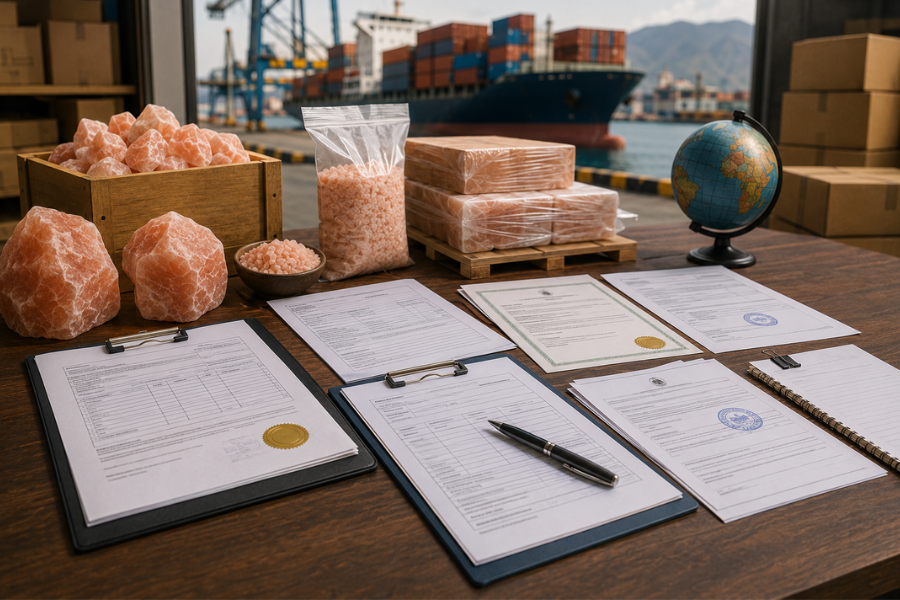
Exporting Himalayan salt products to international markets involves much more than manufacturing high-quality products and arranging transportation. Every shipment must be supported by accurate documentation to ensure it moves smoothly through customs, complies with international trade regulations, and reaches buyers without unnecessary delays. Whether exporting edible Himalayan pink salt, salt lamps, bath salts, cooking slabs, salt tiles, animal salt licks, or decorative products, exporters must prepare several important documents before goods leave the factory. These documents provide customs authorities, shipping companies, freight forwarders, and buyers with essential information about the shipment, including product descriptions, quantities, values, origin, and transportation details. Missing or inaccurate paperwork can result in customs delays, additional storage charges, shipment inspections, or unnecessary financial losses. Fortunately, once exporters understand the purpose of each document and establish an organized documentation process, international shipments become much more efficient. This guide explains the most important export documents required for Himalayan salt products and why they play such an important role in successful global trade.
Why Export Documentation Is So Important
Export documentation serves as the foundation of every successful international shipment because it provides official information that allows products to move legally between countries. Customs authorities rely on these documents to identify the products being exported, calculate applicable duties or taxes, verify the country of origin, and ensure compliance with import regulations. Buyers also depend on accurate documentation because it allows them to clear shipments quickly after arrival while confirming that the products supplied match their purchase orders. Shipping companies require complete paperwork before transporting goods internationally, and banks may also review export documents when transactions involve letters of credit or other international payment methods. Even small documentation errors, such as incorrect product descriptions or inconsistent quantities, can delay customs clearance and increase transportation costs. Reliable Himalayan salt exporters therefore establish careful documentation procedures that verify every detail before shipments leave the factory. Well-prepared export documents improve efficiency, strengthen customer confidence, and reduce unnecessary complications throughout the international shipping process.
Commercial Invoice
One of the most important documents required for every Himalayan salt export shipment is the commercial invoice. This document acts as the official sales record between the exporter and the buyer while providing customs authorities with detailed information about the transaction. A commercial invoice normally includes the exporter and importer details, invoice number, invoice date, product descriptions, Harmonized System (HS) codes where applicable, quantities, unit prices, total shipment value, currency, payment terms, and agreed shipping terms such as FOB or CIF. Customs officials use this information to determine duties, taxes, and the declared value of imported goods. Buyers also rely on the commercial invoice to verify that the shipment matches the agreed purchase order before processing payment or clearing customs. Since this document serves multiple purposes throughout the international trade process, every detail should be checked carefully before shipment. Even small mistakes in product descriptions or pricing can delay customs clearance, increase administrative work, or create unnecessary confusion between exporters and international buyers.
Packing List
The packing list accompanies almost every international shipment and provides detailed information about how the Himalayan salt products have been packed for transportation. Although it resembles the commercial invoice in some respects, its primary purpose is to describe the physical contents of the shipment rather than the commercial transaction itself. A packing list usually includes the number of cartons, pallets, crates, or containers, along with the weight, dimensions, packing method, and product quantities contained within each package. For heavy Himalayan salt products such as salt lamps, cooking slabs, bricks, and architectural tiles, accurate packing information helps freight companies handle cargo safely while assisting customs officers during inspections. Buyers also use the packing list to verify shipments immediately after arrival and confirm that every package has been received according to the purchase order. Well-prepared packing lists improve warehouse organization, simplify unloading procedures, and reduce the possibility of missing or misplaced cartons during transportation. Accurate packing information contributes significantly to smooth logistics and efficient delivery operations.
Certificate of Origin
The Certificate of Origin is another essential export document because it officially confirms the country where the Himalayan salt products were produced. Since authentic Himalayan salt is mined in Pakistan, many international buyers request this document to verify the origin of the products they are purchasing. Customs authorities in importing countries may also require the Certificate of Origin when determining tariff rates, trade preferences, or compliance with bilateral trade agreements. The document is generally issued or certified by an authorized chamber of commerce or another designated authority depending on national export regulations. Buyers appreciate receiving this certificate because it supports product authenticity and provides confidence that the Himalayan salt genuinely originates from Pakistan’s famous salt mines. Exporters should ensure that all details shown on the certificate match the commercial invoice, packing list, and shipping documents to avoid inconsistencies during customs clearance. Proper documentation of product origin strengthens customer trust while supporting transparent international trade practices.
Bill of Lading or Air Waybill
Transportation documents are essential because they officially confirm that the shipping company has accepted the Himalayan salt products for international delivery. For sea freight shipments, the primary document is the Bill of Lading, while air freight shipments use an Air Waybill. These documents contain important shipment details, including the names of the exporter and importer, shipping route, container numbers when applicable, cargo description, package quantity, destination port, and transportation instructions. The Bill of Lading also serves as a document of title in many international trade transactions, making it an especially important legal document. Buyers often require original shipping documents before taking possession of goods after arrival at the destination port. Freight forwarders, shipping companies, customs officials, and banks may all review these documents during different stages of the shipping process. Accurate transportation documentation ensures that Himalayan salt products move efficiently through international logistics networks while reducing delays and misunderstandings between all parties involved in the shipment.
Export Declaration
Most countries require exporters to submit an official export declaration before goods leave the country. This document provides customs authorities with detailed information regarding the shipment, including product descriptions, quantities, values, destination country, exporter information, and applicable tariff classifications. The export declaration allows government agencies to monitor international trade activities, maintain export statistics, and ensure compliance with national trade regulations. In many cases, exporters or their customs agents prepare and submit this declaration electronically before cargo is loaded for shipment. Accurate information is essential because discrepancies between the export declaration and other documents may result in shipment delays or additional customs inspections. For Himalayan salt exporters shipping products to multiple international markets, maintaining organized export declaration records also supports efficient business operations and simplifies future reporting requirements. Properly completed export declarations contribute to smooth customs clearance while demonstrating compliance with international export regulations.
Food Safety Certificates for Edible Himalayan Salt
When exporting edible Himalayan pink salt, additional documentation may be required depending on the regulations of the destination country. Food safety certificates help demonstrate that the salt has been processed under hygienic conditions and complies with applicable food standards. Buyers, food distributors, supermarkets, and food manufacturers frequently request these certificates before placing large commercial orders. Depending on customer requirements, exporters may also provide laboratory test reports, microbiological analysis, mineral composition reports, or certifications such as FDA registration support, ISO certification, or Halal certification where applicable. These documents help importers satisfy local food regulatory requirements while building confidence in product quality and safety. Reliable manufacturers maintain strong quality control systems that support the preparation of these certificates whenever required. Although documentation requirements differ between countries, exporters should always confirm customer expectations before production begins to ensure every required certificate is available before shipment.
Inspection Certificate
Many international buyers request an inspection certificate before accepting a Himalayan salt shipment, especially for large wholesale or private-label orders. This document confirms that the products have been inspected before shipment and meet the agreed quality specifications. Inspections may be carried out by the manufacturer’s internal quality control team or by an independent third-party inspection company if requested by the buyer. During the inspection, professionals verify product dimensions, appearance, packaging quality, labeling accuracy, product quantity, and overall workmanship according to the purchase agreement. For edible Himalayan salt, inspections may also include packaging integrity, grain size consistency, and cleanliness. Decorative products such as salt lamps, cooking slabs, and architectural salt tiles are checked for cracks, chips, surface finish, and structural quality. Providing an inspection certificate increases buyer confidence because it demonstrates that the shipment has been carefully reviewed before export. It also helps reduce disputes after delivery by confirming that products met the agreed standards before leaving the manufacturing facility.
Insurance Certificate
Although cargo insurance is not mandatory for every international shipment, many exporters and importers choose to insure Himalayan salt products during transportation. An insurance certificate provides proof that the shipment is covered against certain risks that may occur while goods are being transported by sea, air, or land. Heavy products such as Himalayan salt lamps, cooking slabs, salt bricks, and decorative panels can be vulnerable to accidental damage if shipments are not handled carefully during loading and unloading. Insurance helps protect both the exporter and the buyer from unexpected financial losses caused by accidents, natural events, theft, or transportation damage covered under the insurance policy. The certificate normally includes details about the insured goods, shipment value, transportation route, policy number, and coverage conditions. Buyers often request a copy of this document when shipments are sold under terms that require the exporter to arrange insurance. Proper insurance provides additional peace of mind throughout the international shipping process.
Product Certifications and Supporting Documents
Depending on the destination market and the specific Himalayan salt products being exported, buyers may request additional supporting documents to verify product quality and regulatory compliance. Food-grade Himalayan salt may require laboratory analysis reports showing purity levels, mineral composition, moisture content, or microbiological testing. Some customers also request certificates related to quality management systems, food safety practices, or religious compliance such as Halal certification. Decorative Himalayan salt products generally require fewer regulatory documents, but large commercial buyers may still request quality reports or manufacturing declarations before placing significant orders. Exporters should discuss documentation requirements with buyers before production begins so there is enough time to prepare all necessary paperwork. Providing complete supporting documents demonstrates professionalism and helps strengthen customer confidence. Well-organized certification records also make future orders easier because buyers often continue working with suppliers who consistently provide accurate documentation alongside reliable product quality.
Payment Documents for International Trade
International trade often involves secure payment methods that require specific documentation before payment is released. When transactions are conducted through a letter of credit, banks carefully examine export documents to ensure they comply exactly with the agreed terms. Documents such as the commercial invoice, packing list, bill of lading, certificate of origin, insurance certificate, and inspection certificate may all be reviewed before payment is processed. Even small discrepancies between documents can delay payment until corrections are made. Exporters should therefore review every document carefully before submitting them to the bank. Businesses using advance payments or other payment methods may require fewer banking documents, but maintaining complete records remains an important business practice. Understanding payment documentation helps exporters receive funds more efficiently while reducing unnecessary delays. Accurate paperwork not only satisfies banking requirements but also strengthens trust between exporters and international buyers by demonstrating careful attention to detail throughout the transaction.
Keeping Export Documentation Organized
Successful Himalayan salt exporters understand that preparing documents is only part of the process. Organizing and storing documentation properly is equally important for future reference, customer support, and business management. Many companies maintain both digital and printed records of invoices, shipping documents, certificates, inspection reports, and export declarations for every shipment. Organized record-keeping makes it easier to respond to customer questions, process repeat orders, manage warranty claims, and satisfy government reporting requirements if needed. It also helps businesses analyze previous shipments, improve logistics planning, and simplify future documentation preparation. Many exporters use inventory and document management software to keep records secure and easily accessible. Even smaller businesses benefit from maintaining systematic filing procedures because organized documentation reduces administrative errors and saves valuable time. Good record management reflects professionalism and supports smoother international business operations as export volumes continue to grow over time.
Common Documentation Mistakes to Avoid
Even experienced exporters occasionally encounter documentation problems, but many common mistakes can be prevented through careful review and communication. Incorrect product descriptions, inconsistent quantities, spelling errors, inaccurate invoice values, missing signatures, or differences between shipping documents can all create customs delays or payment issues. Some exporters also forget to verify customer-specific documentation requirements before shipment, resulting in missing certificates or incomplete paperwork after cargo has already been dispatched. Another common mistake is preparing documents too late, leaving insufficient time to correct errors before scheduled shipping dates. Exporters should establish a checklist that verifies every required document has been completed accurately before products leave the factory. Careful coordination between production, quality control, logistics, and documentation teams helps eliminate unnecessary mistakes. Reviewing documents multiple times before submission significantly reduces the likelihood of customs delays, additional storage charges, or customer dissatisfaction. Attention to documentation details protects both the shipment and the exporter’s professional reputation.
How Experienced Exporters Simplify the Process
As businesses gain experience in exporting Himalayan salt, documentation becomes a well-organized part of daily operations rather than a complicated task. Professional exporters develop standardized procedures that ensure every shipment includes the correct paperwork, accurate product information, and complete supporting certificates. Many companies assign dedicated export coordinators who communicate closely with production teams, freight forwarders, customs brokers, and buyers throughout the shipping process. This coordinated approach reduces delays, improves communication, and ensures documentation is prepared correctly the first time. Experienced exporters also stay informed about changing international trade regulations so they can adapt documentation procedures whenever destination countries introduce new import requirements. Strong relationships with freight forwarders and customs specialists further simplify export operations because experienced logistics partners help verify paperwork before shipments depart. These organized systems allow exporters to handle increasing order volumes efficiently while maintaining excellent customer service and reliable international delivery performance.
Conclusion
Export documentation is one of the most important aspects of the Himalayan salt export business because it supports smooth customs clearance, efficient transportation, secure payment processing, and successful international trade. Documents such as the commercial invoice, packing list, certificate of origin, bill of lading, export declaration, inspection certificate, insurance certificate, and supporting certifications all work together to provide complete information about every shipment. Preparing these documents accurately helps exporters avoid customs delays, reduce unnecessary costs, strengthen customer confidence, and maintain compliance with international trade regulations. Reliable Himalayan salt exporters understand that professional documentation is just as important as manufacturing high-quality products because both contribute directly to customer satisfaction and long-term business success. As global demand for Himalayan salt continues expanding across food, wellness, hospitality, agriculture, and interior design industries, businesses that invest in organized documentation procedures will be better positioned to build lasting relationships with buyers around the world. Careful preparation, attention to detail, and strong communication remain the foundation of successful Himalayan salt exports.